
Transformations and Congruence: Polygon Translation
Loading the math board and drawing, please wait…
In collections
Transformations and Congruence Activities 1-7
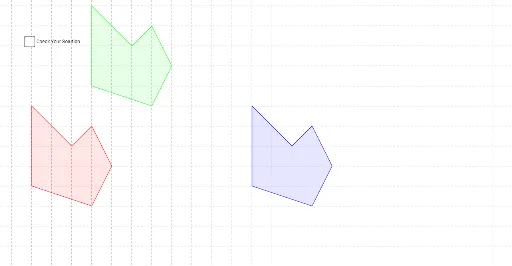
This GeoGebra example demonstrates the translation of a polygon by a vector and explores the concept of congruence. The core mathematical concepts include translation transformations, congruent figures, and the preservation of corresponding vertices and sides. Construction highlights: using the Polygon command to create polygon poly1, defining vector u, and applying the Translate command to shift the polygon and all its edges and vertices along u, producing the translated polygon poly1' and its elements, followed by a second translation to obtain poly1_1, illustrating successive translations. Suitable for middle school geometry, this interactive tool helps students visualize that translation preserves shape and size, reinforcing the idea of congruent figures.
GeoGebra Commands & Parameters
Polygon(A, B, C, D, E, F) → poly1, a, b, c, d, e, fVector(G, H) → uTranslate(A, u) → A'Translate(B, u) → B'Translate(C, u) → C'Translate(D, u) → D'Translate(E, u) → E'Translate(F, u) → F'Polygon(A', B', C', D', E', F') → poly1', a', b', c', d', e', f'Polygon(A_1, B_1, C_1, D_1, E_1, F_1) → poly1_1, a_1, b_1, c_1, d_1, e_1, f_1
AI Drawing Prompt Reference
Draw a hexagon and define a vector from one point to another. Translate each vertex of the hexagon by this vector to create a second hexagon, and connect corresponding vertices to show the translation. Then translate the second hexagon again by the same vector to obtain a third hexagon. All hexagons should remain identical in shape and size, only shifted in position, demonstrating that translation preserves congruence.
The prompt above was compiled from the original drawing commands and is for reference only.