
Transformations and Congruence: Interactive Exploration of Translation, Rotation
Loading the math board and drawing, please wait…
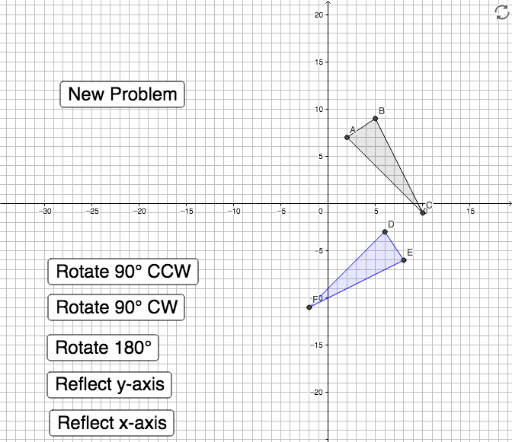
① This GeoGebra example dynamically illustrates how geometric figures remain congruent under transformations such as translation, rotation, and reflection, making the invariance of shape and size visually evident. ② Core mathematical concepts include congruence, geometric transformations (translation, rotation, reflection), and their composition, involving polygon vertices, translation vectors, and reflection axes. ③ Construction highlights: from the summary, it uses Random to generate figures, Textfield and InputBox for parameter input, Vector for translation vectors, Polygon to build polygons, Translate for translation, ReflectR for reflection, Vertex to extract vertices, and multiple buttons (button1 to button7) to trigger different transformations, with If conditions and sliders for interactive parameter control. ④ Suitable for middle and high school students learning geometry transformations and congruence, and for teachers to demonstrate in class or for students to explore independently, deepening understanding of the mathematical essence and geometric intuition.
GeoGebra Commands & Parameters
Random(4, 6) → bRandom(6, 10) → cRandom(0, 3) → aRandom(-3, 10) → dRandom(-3, 10) → eRandom(-3, 10) → fTextfield() → InputBox1Textfield() → InputBox2Vector((0, 0), (horizontal, vertical)) → uPolygon(R, S, T) → poly2, t, r_1, s_1Random(1, 5) → problemPolygon(A, B, C) → poly1, c_1, a_1, b_1Random(-10, 10) → gRandom(-10, 10) → hVector((0, 0), (g, h)) → vIf(problem < 2, Polygon[Rotate[R, 90°, (0, 0)], Rotate[S, 90°, (0, 0)], Rotate[T, 90°, (0, 0)]], If[problem < 3, Polygon[Rotate[R, (-(90°)), (0, 0)], Rotate[S, (-(90°)), (0, 0)], Rotate[T, (-(90°)), (0, 0)]], If[problem < 4, Polygon[Rotate[R, 180°, (0, 0)], Rotate[S, 180°, (0, 0)], Rotate[T, 180°, (0, 0)]], If[problem < 5, Polygon[Mirror[R, x = 0], Mirror[S, x = 0], Mirror[T, x = 0]], Polygon[Mirror[R, y = 0], Mirror[S, y = 0], Mirror[T, y = 0]]]]]) → poly3Translate(poly3, v) → poly3'Vertex(poly3') → D, E, F