
Tilted Duct Collecting Rain
Loading the math board and drawing, please wait…
In collections
Rate & Accumulation Yr 4 Much&Fast
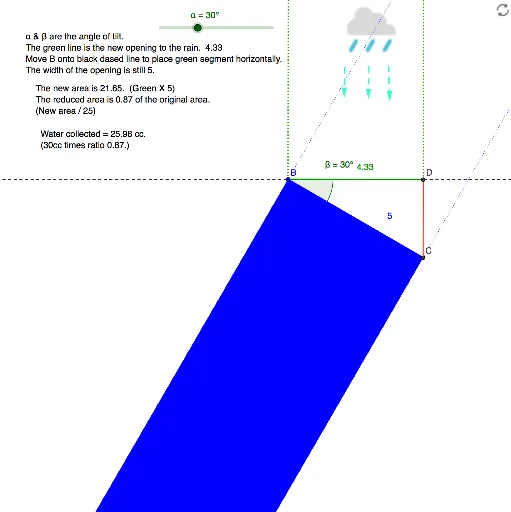
This example demonstrates a geometric model of a tilted duct collecting rain. It involves core math concepts like circles, polygons, solid geometry, vectors, and transformations. Construction highlights include commands such as Rotate, Angle, Ray, Circle, Intersect, OrthogonalLine, Segment, Line, Point, Polygon, and Vector. Suitable for high school geometry and analytical geometry teaching, helping students understand spatial geometric transformations and real-world applications.
GeoGebra Commands & Parameters
Rotate(A, α, B) → A'Angle(A, B, A') → βRay(B, A) → aRay(B, A') → bCircle(B, 5) → cIntersect(c, a) → C,OrthogonalLine(C, b) → dIntersect(b, d) → DSegment(B, D) → eSegment(D, C) → fSegment(C, B) → gOrthogonalLine(B, g) → hOrthogonalLine(C, g) → iLine(B, d) → jLine(D, xAxis) → kPoint(j) → EPoint(d) → FRay(D, F) → lRay(B, E) → mPoint(h) → GPoint(i) → HPolygon(G, B, C, H) → poly1, g_1, b_1, c_1, h_1Vector(K, L) → uVector(M, N) → vVector(O, P) → wPolygon(Q, T, S, R) → poly2, q, t, s, rPolygon(Q, U, V, W) → poly3, q_1, u_1, v_1, w_1
AI Drawing Prompt Reference
Draw a geometric model of a tilted duct collecting rain, involving circles, polygons, and solid geometry. Start by constructing a tilted duct using rotations and angles, then define its cross-section with a circle and rays. Construct the edges of the duct using intersections and perpendicular lines, forming closed polygons. Finally, add vectors to indicate directions and combine multiple polygons to display the duct's 3D structure.
The prompt above was compiled from the original drawing commands and is for reference only.