
Tidal Accelerations (To Scale)
Loading the math board and drawing, please wait…
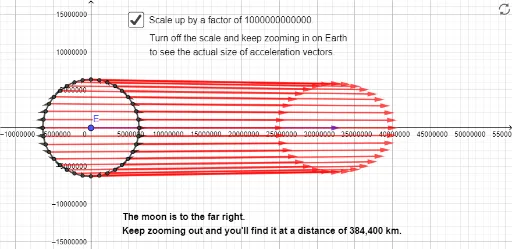
① This example demonstrates tidal acceleration vectors at various points on Earth's surface, explaining the formation of tidal bulges and tides with a true-to-scale representation. ② Core mathematical concepts include universal gravitation, centripetal acceleration, vector addition and decomposition, and the distribution of tidal (tractive) forces. ③ Construction highlights: using GeoGebra's Circle command to define Earth and the Moon's orbit, and Vector command to draw acceleration vectors; key objects include scale factor, Earth center E, Moon mass m, gravitational parameter gm, Earth-Moon distance aEM, and auxiliary points (E0m, E9m, E1–E27) for computing and plotting the vector field. ④ Suitable for high school physics or introductory astronomy/mechanics courses, as well as mathematics classes focusing on vector operations and geometric construction, helping students visualize how vector direction and magnitude vary with position.
GeoGebra Commands & Parameters
Circle(E, re) → E_{c}Vector(E9, (x(E9) + x(E9m), y(E9) + y(E9m))) → E9MVector(E9, (x(E9) + x(E9e), y(E9) + y(E9e))) → E9EVector(E0, (x(E0) + x(E0m), y(E0) + y(E0m))) → E0MVector(E0, (x(E0) + x(E0e), y(E0) + y(E0e))) → E0EVector(E1, (x(E1) + x(E1m), y(E1) + y(E1m))) → E1MVector(E1, (x(E1) + x(E1e), y(E1) + y(E1e))) → E1EVector(E2, (x(E2) + x(E2m), y(E2) + y(E2m))) → E2MVector(E2, (x(E2) + x(E2e), y(E2) + y(E2e))) → E2EVector(E3, (x(E3) + x(E3m), y(E3) + y(E3m))) → E3MVector(E3, (x(E3) + x(E3e), y(E3) + y(E3e))) → E3EVector(E4, (x(E4) + x(E4m), y(E4) + y(E4m))) → E4MVector(E4, (x(E4) + x(E4e), y(E4) + y(E4e))) → E4EVector(E5, (x(E5) + x(E5m), y(E5) + y(E5m))) → E5MVector(E5, (x(E5) + x(E5e), y(E5) + y(E5e))) → E5EVector(E6, (x(E6) + x(E6m), y(E6) + y(E6m))) → E6MVector(E6, (x(E6) + x(E6e), y(E6) + y(E6e))) → E6EVector(E7, (x(E7) + x(E7m), y(E7) + y(E7m))) → E7MVector(E7, (x(E7) + x(E7e), y(E7) + y(E7e))) → E7EVector(E8, (x(E8) + x(E8m), y(E8) + y(E8m))) → E8MVector(E8, (x(E8) + x(E8e), y(E8) + y(E8e))) → E8EVector(E10, (x(E10) + x(E10m), y(E10) + y(E10m))) → E10MVector(E10, (x(E10) + x(E10e), y(E10) + y(E10e))) → E10EVector(E11, (x(E11) + x(E11m), y(E11) + y(E11m))) → E11MVector(E11, (x(E11) + x(E11e), y(E11) + y(E11e))) → E11EVector(E12, (x(E12) + x(E12m), y(E12) + y(E12m))) → E12MVector(E12, (x(E12) + x(E12e), y(E12) + y(E12e))) → E12EVector(E13, (x(E13) + x(E13m), y(E13) + y(E13m))) → E13MVector(E13, (x(E13) + x(E13e), y(E13) + y(E13e))) → E13EVector(E14, (x(E14) + x(E14m), y(E14) + y(E14m))) → E14MVector(E14, (x(E14) + x(E14e), y(E14) + y(E14e))) → E14EVector(E15, (x(E15) + x(E15m), y(E15) + y(E15m))) → E15MVector(E15, (x(E15) + x(E15e), y(E15) + y(E15e))) → E15EVector(E16, (x(E16) + x(E16m), y(E16) + y(E16m))) → E16MVector(E16, (x(E16) + x(E16e), y(E16) + y(E16e))) → E16EVector(E17, (x(E17) + x(E17m), y(E17) + y(E17m))) → E17MVector(E17, (x(E17) + x(E17e), y(E17) + y(E17e))) → E17EVector(E18, (x(E18) + x(E18m), y(E18) + y(E18m))) → E18MVector(E18, (x(E18) + x(E18e), y(E18) + y(E18e))) → E18EVector(E19, (x(E19) + x(E19m), y(E19) + y(E19m))) → E19MVector(E19, (x(E19) + x(E19e), y(E19) + y(E19e))) → E19EVector(E20, (x(E20) + x(E20m), y(E20) + y(E20m))) → E20MVector(E20, (x(E20) + x(E20e), y(E20) + y(E20e))) → E20EVector(E21, (x(E21) + x(E21m), y(E21) + y(E21m))) → E21MVector(E21, (x(E21) + x(E21e), y(E21) + y(E21e))) → E21EVector(E22, (x(E22) + x(E22m), y(E22) + y(E22m))) → E22MVector(E22, (x(E22) + x(E22e), y(E22) + y(E22e))) → E22EVector(E23, (x(E23) + x(E23m), y(E23) + y(E23m))) → E23MVector(E23, (x(E23) + x(E23e), y(E23) + y(E23e))) → E23EVector(E24, (x(E24) + x(E24m), y(E24) + y(E24m))) → E24MVector(E24, (x(E24) + x(E24e), y(E24) + y(E24e))) → E24EVector(E25, (x(E25) + x(E25m), y(E25) + y(E25m))) → E25MVector(E25, (x(E25) + x(E25e), y(E25) + y(E25e))) → E25EVector(E26, (x(E26) + x(E26m), y(E26) + y(E26m))) → E26MVector(E26, (x(E26) + x(E26e), y(E26) + y(E26e))) → E26EVector(E27, (x(E27) + x(E27m), y(E27) + y(E27m))) → E27MVector(E27, (x(E27) + x(E27e), y(E27) + y(E27e))) → E27EVector(E28, (x(E28) + x(E28m), y(E28) + y(E28m))) → E28MVector(E28, (x(E28) + x(E28e), y(E28) + y(E28e))) → E28EVector(E29, (x(E29) + x(E29m), y(E29) + y(E29m))) → E29MVector(E29, (x(E29) + x(E29e), y(E29) + y(E29e))) → E29EVector(E30, (x(E30) + x(E30m), y(E30) + y(E30m))) → E30MVector(E30, (x(E30) + x(E30e), y(E30) + y(E30e))) → E30EVector(E31, (x(E31) + x(E31m), y(E31) + y(E31m))) → E31MVector(E31, (x(E31) + x(E31e), y(E31) + y(E31e))) → E31EVector(E32, (x(E32) + x(E32m), y(E32) + y(E32m))) → E32MVector(E32, (x(E32) + x(E32e), y(E32) + y(E32e))) → E32EVector(E33, (x(E33) + x(E33m), y(E33) + y(E33m))) → E33MVector(E33, (x(E33) + x(E33e), y(E33) + y(E33e))) → E33EVector(E34, (x(E34) + x(E34m), y(E34) + y(E34m))) → E34MVector(E34, (x(E34) + x(E34e), y(E34) + y(E34e))) → E34EVector(E35, (x(E35) + x(E35m), y(E35) + y(E35m))) → E35MVector(E35, (x(E35) + x(E35e), y(E35) + y(E35e))) → E35ECircle(M, rm) → E_{m}
AI Drawing Prompt Reference
Draw a to-scale diagram of tidal accelerations. Place Earth as a circle with its center marked, and the Moon at a distance to the right. On Earth's surface, distribute many sample points evenly. From each point, draw two vectors: one pointing toward the Moon (representing lunar gravitational acceleration) and one pointing toward Earth's center (representing Earth's gravitational acceleration). Scale the vector lengths according to real physical proportions to show how tidal forces vary across the surface. The diagram should clearly illustrate the direction and magnitude changes of tractive forces, explaining the formation of tidal bulges.
The prompt above was compiled from the original drawing commands and is for reference only.