
Tidal Accelerations along Earth-Moon Line
Loading the math board and drawing, please wait…
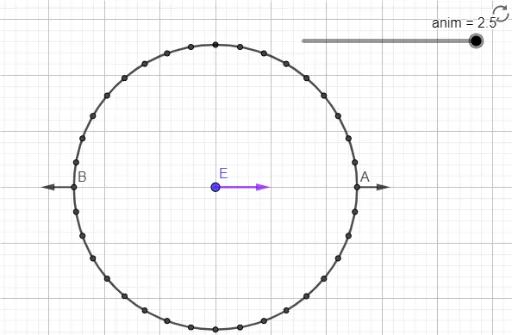
This example demonstrates tidal accelerations along the line joining Earth and Moon. It involves core mathematical concepts like vectors, displacement, geometric construction, and coordinate systems. Key GeoGebra commands and objects used in the construction include Circle, Vector, and Translate. Suitable for high school and above students to learn about tidal mechanics and vector operations.
GeoGebra Commands & Parameters
Circle(E, (re * s)) → E_{c}'Circle(E, re) → E_{c}Vector(E9, (x(E9) + x(E9m), y(E9) + y(E9m))) → E9MVector(E9, (x(E9) + x(E9e), y(E9) + y(E9e))) → E9EVector(E0, (x(E0) + x(E0m), y(E0) + y(E0m))) → E0MVector(E0, (x(E0) + x(E0e), y(E0) + y(E0e))) → E0EVector(E1, (x(E1) + x(E1m), y(E1) + y(E1m))) → E1MVector(E1, (x(E1) + x(E1e), y(E1) + y(E1e))) → E1EVector(E2, (x(E2) + x(E2m), y(E2) + y(E2m))) → E2MVector(E2, (x(E2) + x(E2e), y(E2) + y(E2e))) → E2EVector(E3, (x(E3) + x(E3m), y(E3) + y(E3m))) → E3MVector(E3, (x(E3) + x(E3e), y(E3) + y(E3e))) → E3EVector(E4, (x(E4) + x(E4m), y(E4) + y(E4m))) → E4MVector(E4, (x(E4) + x(E4e), y(E4) + y(E4e))) → E4EVector(E5, (x(E5) + x(E5m), y(E5) + y(E5m))) → E5MVector(E5, (x(E5) + x(E5e), y(E5) + y(E5e))) → E5EVector(E6, (x(E6) + x(E6m), y(E6) + y(E6m))) → E6MVector(E6, (x(E6) + x(E6e), y(E6) + y(E6e))) → E6EVector(E7, (x(E7) + x(E7m), y(E7) + y(E7m))) → E7MVector(E7, (x(E7) + x(E7e), y(E7) + y(E7e))) → E7EVector(E8, (x(E8) + x(E8m), y(E8) + y(E8m))) → E8MVector(E8, (x(E8) + x(E8e), y(E8) + y(E8e))) → E8EVector(E10, (x(E10) + x(E10m), y(E10) + y(E10m))) → E10MVector(E10, (x(E10) + x(E10e), y(E10) + y(E10e))) → E10EVector(E11, (x(E11) + x(E11m), y(E11) + y(E11m))) → E11MVector(E11, (x(E11) + x(E11e), y(E11) + y(E11e))) → E11EVector(E12, (x(E12) + x(E12m), y(E12) + y(E12m))) → E12MVector(E12, (x(E12) + x(E12e), y(E12) + y(E12e))) → E12EVector(E13, (x(E13) + x(E13m), y(E13) + y(E13m))) → E13MVector(E13, (x(E13) + x(E13e), y(E13) + y(E13e))) → E13EVector(E14, (x(E14) + x(E14m), y(E14) + y(E14m))) → E14MVector(E14, (x(E14) + x(E14e), y(E14) + y(E14e))) → E14EVector(E15, (x(E15) + x(E15m), y(E15) + y(E15m))) → E15MVector(E15, (x(E15) + x(E15e), y(E15) + y(E15e))) → E15EVector(E16, (x(E16) + x(E16m), y(E16) + y(E16m))) → E16MVector(E16, (x(E16) + x(E16e), y(E16) + y(E16e))) → E16EVector(E17, (x(E17) + x(E17m), y(E17) + y(E17m))) → E17MVector(E17, (x(E17) + x(E17e), y(E17) + y(E17e))) → E17EVector(E18, (x(E18) + x(E18m), y(E18) + y(E18m))) → E18MVector(E18, (x(E18) + x(E18e), y(E18) + y(E18e))) → E18EVector(E19, (x(E19) + x(E19m), y(E19) + y(E19m))) → E19MVector(E19, (x(E19) + x(E19e), y(E19) + y(E19e))) → E19EVector(E20, (x(E20) + x(E20m), y(E20) + y(E20m))) → E20MVector(E20, (x(E20) + x(E20e), y(E20) + y(E20e))) → E20EVector(E21, (x(E21) + x(E21m), y(E21) + y(E21m))) → E21MVector(E21, (x(E21) + x(E21e), y(E21) + y(E21e))) → E21EVector(E22, (x(E22) + x(E22m), y(E22) + y(E22m))) → E22MVector(E22, (x(E22) + x(E22e), y(E22) + y(E22e))) → E22EVector(E23, (x(E23) + x(E23m), y(E23) + y(E23m))) → E23MVector(E23, (x(E23) + x(E23e), y(E23) + y(E23e))) → E23EVector(E24, (x(E24) + x(E24m), y(E24) + y(E24m))) → E24MVector(E24, (x(E24) + x(E24e), y(E24) + y(E24e))) → E24EVector(E25, (x(E25) + x(E25m), y(E25) + y(E25m))) → E25MVector(E25, (x(E25) + x(E25e), y(E25) + y(E25e))) → E25EVector(E26, (x(E26) + x(E26m), y(E26) + y(E26m))) → E26MVector(E26, (x(E26) + x(E26e), y(E26) + y(E26e))) → E26EVector(E27, (x(E27) + x(E27m), y(E27) + y(E27m))) → E27MVector(E27, (x(E27) + x(E27e), y(E27) + y(E27e))) → E27EVector(E28, (x(E28) + x(E28m), y(E28) + y(E28m))) → E28MVector(E28, (x(E28) + x(E28e), y(E28) + y(E28e))) → E28EVector(E29, (x(E29) + x(E29m), y(E29) + y(E29m))) → E29MVector(E29, (x(E29) + x(E29e), y(E29) + y(E29e))) → E29EVector(E30, (x(E30) + x(E30m), y(E30) + y(E30m))) → E30MVector(E30, (x(E30) + x(E30e), y(E30) + y(E30e))) → E30EVector(E31, (x(E31) + x(E31m), y(E31) + y(E31m))) → E31MVector(E31, (x(E31) + x(E31e), y(E31) + y(E31e))) → E31EVector(E32, (x(E32) + x(E32m), y(E32) + y(E32m))) → E32MVector(E32, (x(E32) + x(E32e), y(E32) + y(E32e))) → E32EVector(E33, (x(E33) + x(E33m), y(E33) + y(E33m))) → E33MVector(E33, (x(E33) + x(E33e), y(E33) + y(E33e))) → E33EVector(E34, (x(E34) + x(E34m), y(E34) + y(E34m))) → E34MVector(E34, (x(E34) + x(E34e), y(E34) + y(E34e))) → E34EVector(E35, (x(E35) + x(E35m), y(E35) + y(E35m))) → E35MVector(E35, (x(E35) + x(E35e), y(E35) + y(E35e))) → E35ECircle(M, (rm * s)) → E_{m}'Circle(M, rm) → E_{m}Vector(A, (x(A) + x(E0m'), y(A) + y(E0m'))) → E0M'Vector(A, (x(A) + x(E0e'), y(A) + y(E0e'))) → E0E'Vector(B, (x(B) + x(E18m'), y(B) + y(E18m'))) → E18M'Vector(B, (x(B) + x(E18e'), y(B) + y(E18e'))) → E18E'Translate(Vector[Rotate[aEM', (anim * π)]], ((anim * Distance[E, A]), 0)) → uTranslate(Vector[Rotate[aEM', ((anim - 1) * π)]], (((-(anim - 1)) * Distance[E, B]), 0)) → v
AI Drawing Prompt Reference
Draw a line segment between Earth and the Moon, and display vectors representing tidal accelerations along this line. First, draw a circle for Earth and another for the Moon. Then, draw a line segment between the two circles. Next, draw multiple vectors along this line segment, with each vector representing the tidal acceleration at a specific point. The starting point of each vector is on the line segment, and the endpoint is along the extension of the line segment in the direction of the line. Ensure that the length and direction of each vector reflect the actual changes in tidal acceleration.
The prompt above was compiled from the original drawing commands and is for reference only.