
Three Pyramids to Form a Cube
Loading the math board and drawing, please wait…
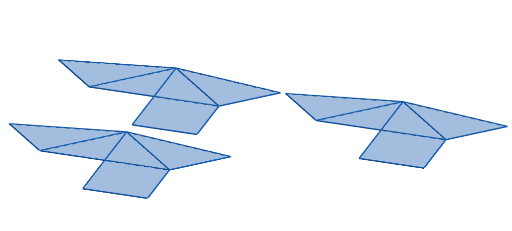
This example demonstrates how three isosceles triangular pyramids can be combined to form a cube. The key mathematical concepts involved include solid geometry, volume calculation, and geometric transformations. Construction involves using GeoGebra commands such as Pyramid, Rotate, Translate to build pyramids and cube faces. Suitable for middle or high school mathematics courses to understand three-dimensional geometric structures and transformation relationships.
GeoGebra Commands & Parameters
If(t < 1, 0, If[t < 2, t - 1, 1]) → t2If(t < 1, t, 1) → t1Pyramid(A, B, C, D, E) → a, faceABCD, edgeAE, edgeBE, edgeCE, edgeDE, faceABE, faceBCE, faceCDE, faceADE, edgeAB, edgeBC, edgeCD, edgeADRotate(faceCDE, (90° * b), edgeCD) → faceCDE'Rotate(Rotate[faceBCE, (90° * b), edgeCE], (90° * b), edgeCD) → t1_{1}Rotate(Rotate[faceADE, (-((90° * b))), edgeDE], (90° * b), edgeCD) → t2_{1}Rotate(Rotate[Rotate[faceABE, (90° * b), edgeAE], (-((90° * b))), edgeDE], (90° * b), edgeCD) → t4Translate(faceABCD, Vector[(0, 0)]) → faceABCD'PointIn(faceABCD') → OVector(O, P) → uVector(O, Q) → vOrthogonalLine(P, xOyPlane) → fOrthogonalLine(Q, xOyPlane) → gIf(t < 2, 0, If[t < 3, t - 2, 1]) → t3Rotate(Rotate[Translate[faceABCD', u], (-90° * t2), f], (90° * t3), Rotate[Segment[Translate[A, u], Translate[B, u]], (-90° * t2), f]) → q3Rotate(Rotate[Translate[faceCDE', u], (-90° * t2), f], (90° * t3), Rotate[Segment[Translate[A, u], Translate[B, u]], (-90° * t2), f]) → t12Rotate(Rotate[Translate[t2_{1}, u], (-90° * t2), f], (90° * t3), Rotate[Segment[Translate[A, u], Translate[B, u]], (-90° * t2), f]) → t6Rotate(Rotate[Translate[t1_{1}, u], (-90° * t2), f], (90° * t3), Rotate[Segment[Translate[A, u], Translate[B, u]], (-90° * t2), f]) → t13Rotate(Rotate[Translate[t4, u], (-90° * t2), f], (90° * t3), Rotate[Segment[Translate[A, u], Translate[B, u]], (-90° * t2), f]) → t7Rotate(Rotate[Translate[faceABCD', v], (90° * t2), g], (90° * t3), Rotate[Segment[Translate[B, v], Translate[C, v]], (90° * t2), g]) → q1Rotate(Rotate[Translate[faceCDE', v], (90° * t2), g], (90° * t3), Rotate[Segment[Translate[B, v], Translate[C, v]], (90° * t2), g]) → t8Rotate(Rotate[Translate[t2_{1}, v], (90° * t2), g], (90° * t3), Rotate[Segment[Translate[B, v], Translate[C, v]], (90° * t2), g]) → t9Rotate(Rotate[Translate[t1_{1}, v], (90° * t2), g], (90° * t3), Rotate[Segment[Translate[B, v], Translate[C, v]], (90° * t2), g]) → t5Rotate(Rotate[Translate[t4, v], (90° * t2), g], (90° * t3), Rotate[Segment[Translate[B, v], Translate[C, v]], (90° * t2), g]) → t10
AI Drawing Prompt Reference
Draw a 3D figure where three congruent isosceles triangular pyramids combine to form the outer appearance of a cube. First construct one pyramid in space with a quadrilateral base face and several triangular faces connecting the base vertices to an apex. Then rotate the relevant triangular faces around the edges of the base to bring them into positions matching adjacent cube faces. Apply translations to shift the base face to a new location, and use vectors from the shifted base position toward two direction points to define the motion axes. Construct orthogonal lines to these reference planes for rotation bases, then perform additional rotations and translations to place the remaining faces consistently. End with the three pyramids forming a cube-like solid with corresponding exterior faces.
The prompt above was compiled from the original drawing commands and is for reference only.