
This or That: Rectangles? – Exploring Polygons, Rotation, and Parametric Curves
Loading the math board and drawing, please wait…
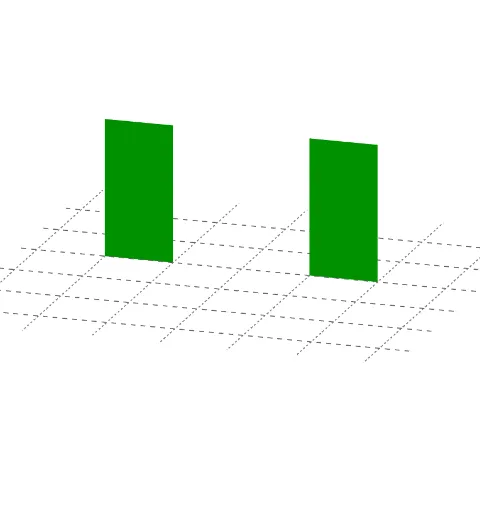
This GeoGebra example presents an interactive comparison of rectangles versus non-rectangular shapes such as trapezoids, ellipses, and parabolas, focusing on how rotation and parametric representation affect geometric classification. The core mathematical concepts include polygon properties, rotation transformations, parametric curves, conic sections (ellipse and parabola), and correlation between shape attributes. The construction uses GeoGebra commands: Polygon to create polygons q1 and q2, Rotate to generate rotated versions q1' and q2', and Surface to build surfaces, with auxiliary objects f, g, h, i, j, k, l, m, n, a, b, c, d, e, o supporting the dynamic visualization. This resource is ideal for middle and high school geometry classes, teacher training, or self-study in transformation geometry, helping learners visually distinguish rectangle characteristics under rotation and parametric variation.
GeoGebra Commands & Parameters
Polygon((2, 0, 0), (4, 0, 0), (4, 0, 4), (2, 0, 4)) → q1, f, g, h, iPolygon((-2, 0, 0), (-4, 0, 0), (-4, 0, 4), (-2, 0, 4)) → q2, j, k, l, mRotate(q1, n, xAxis) → q1'Rotate(q2, n, Line[(-2, 0, 0), (-2, 0, 1)]) → q2'Surface(k, n, Line[(-2, 0, 0), (-2, 0, 1)]) → aSurface(l, n, Line[(-2, 0, 0), (-2, 0, 1)]) → bSurface(m, n, Line[(-2, 0, 0), (-2, 0, 1)]) → cSurface(h, n, xAxis) → dSurface(i, n, xAxis) → eSurface(g, n, xAxis) → o