
Poorly Drawn Parallelograms 2: Randomized Transformations
Loading the math board and drawing, please wait…
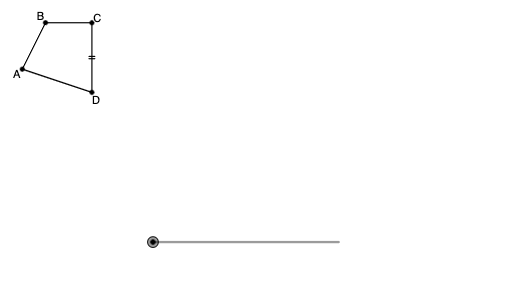
This example demonstrates how “imprecise” or randomized construction of parallelograms can still preserve global geometric constraints while producing visible local discrepancies and iterative evolution. It centers on parallelogram geometry (as a special polygon), geometric transformations controlled by parameters, and the use of exponent/scale-like quantities (often linked to fractal-style iteration and probability-style parameter choices in the visualization). Construction highlights from the GeoGebra command list: the diagram is built by repeatedly creating polygons using Polygon for vertex sets (A,B,C,D), (A1,B1,C1,D1), (A2,B2,C2,D2), (A3,B3,C3,D3), and (A4,B4,C4,D4). The presence of parameter symbols q1 and a,b,c,d (together with subscripted variants q1_1, a_1…d_1, q1_2…d_2, etc.) indicates a parameterized generation of successive vertex coordinates, with multiple redraws to show layered/iterated behavior. Suitable for advanced high school through early university, especially for geometry construction, dynamic geometry, and mathematical visualization of transformation-driven shape changes.
GeoGebra Commands & Parameters
Polygon(A, B, C, D) → q1, a, b, c, dPolygon(A_{1}, B_{1}, C_{1}, D_{1}) → q1_{1}, a_{1}, b_{1}, c_{1}, d_{1}Polygon(A_{2}, B_{2}, C_{2}, D_{2}) → q1_{2}, a_{2}, b_{2}, c_{2}, d_{2}Polygon(A_{3}, B_{3}, C_{3}, D_{3}) → q1_{3}, a_{3}, b_{3}, c_{3}, d_{3}Polygon(A_{4}, B_{4}, C_{4}, D_{4}) → q1_{4}, a_{4}, b_{4}, c_{4}, d_{4}Polygon(A_{5}, B_{5}, C_{5}, D_{5}) → q1_{5}, a_{5}, b_{5}, c_{5}, d_{5}Polygon(A_{6}, B_{6}, C_{6}, D_{6}) → q1_{6}, a_{6}, b_{6}, c_{6}, d_{6}Polygon(A_{7}, B_{7}, C_{7}, D_{7}) → q1_{7}, a_{7}, b_{7}, c_{7}, d_{7}Polygon(E, F, G, H) → q2, e, f_1, g_1, h_1Polygon(I, J, K, L) → q3, i_1, j_1, k_1, l_1Polygon(I_{1}, J_{1}, K_{1}, L_{1}) → q3_{1}, i_{2}, j_{2}, k_{2}, l_{2}
AI Drawing Prompt Reference
Create a composition of iteratively evolving parallelograms. Start by drawing a base parallelogram in the center of the canvas, then generate multiple layered copies through parameterized transformations that introduce slight random deviations and positional offsets, creating an overlapping visual effect. Continue adding more iterations of parallelograms while also placing two additional distinct quadrilateral structures elsewhere in the composition, altogether forming a complex arrangement demonstrating geometric constraints versus randomized transformations.
The prompt above was compiled from the original drawing commands and is for reference only.