
Theorems of Differential Calculus
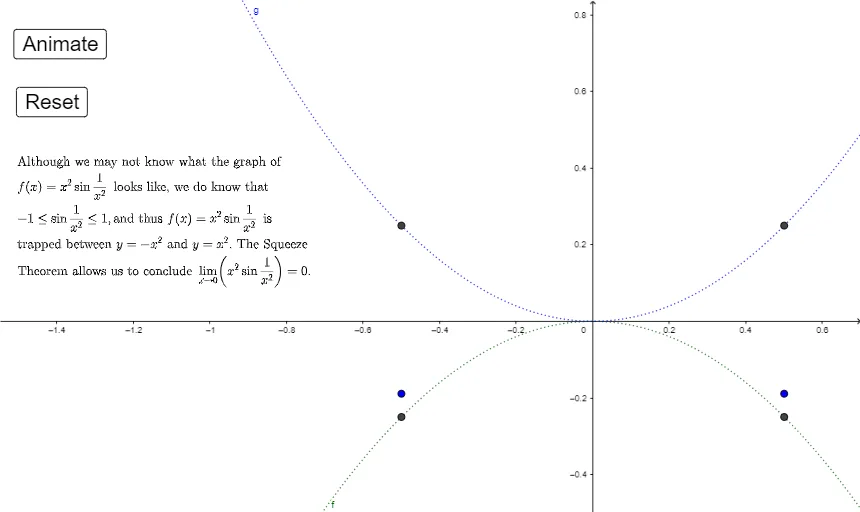
Loading the math board and drawing, please wait…
In collections
Theorems of Differential Calculus
This example illustrates several important theorems in differential calculus, such as the Mean Value Theorem and L'Hôpital's Rule. By constructing functions f, g, and h, and adjusting parameters with slider animation, one can gain a deeper understanding of these theorems and their applications. Suitable for university mathematics students and educators.
GeoGebra Commands & Parameters
f(x) = (-x^(2))g(x) = x^(2)h(x) = (x^(2) * sin(1 / x^(2)))Numeric a(-0.5)Numeric b(0.5)Numeric c(-0.5)Numeric d(0.5)(a, f(a))(b, f(b))(c, g(c))(d, g(d))Numeric e(-0.5)Numeric i(0.5)(e, h(e))(i, h(i))
AI Drawing Prompt Reference
Draw a coordinate plane illustrating differential calculus theorems. Include three function curves: a downward-opening parabola, an upward-opening parabola, and a curve oscillating rapidly near the origin with amplitude proportional to x squared. On each curve, mark two points on opposite sides of the origin with solid dots. Provide four adjustable numeric parameters to control the x-coordinates of these points, allowing slider-based animation. The graph should clearly show function values at interval endpoints for exploring theorems like the Mean Value Theorem.
The prompt above was compiled from the original drawing commands and is for reference only.