
The Number e as the Slope of a Tangent
Loading the math board and drawing, please wait…
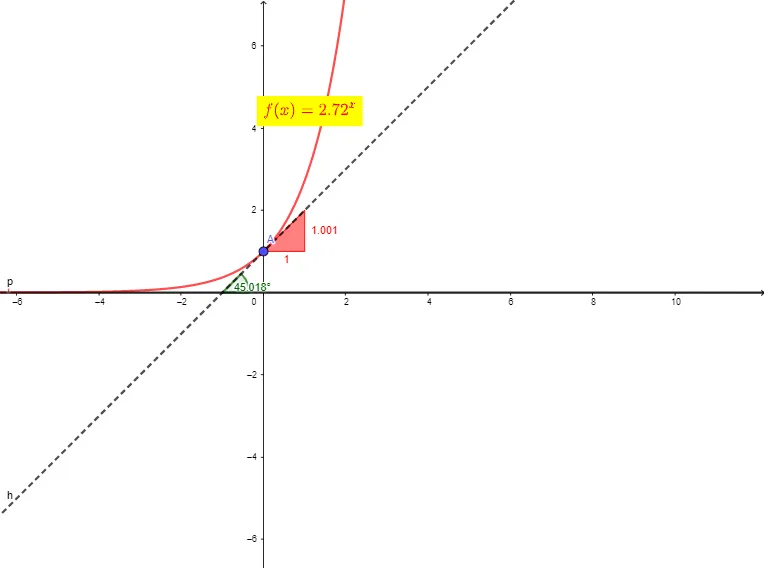
This GeoGebra example dynamically illustrates the geometric meaning of the natural constant e: for the exponential function f(x)=e^x, the slope of the tangent at any point A equals the function value at that point, visually demonstrating the unique property that the derivative of e^x is itself. Core mathematical concepts include exponential functions, derivatives (tangent slopes), the natural constant e, and special points. Construction details: using GeoGebra commands such as Textfield (input box) to let users change the base, Tangent to construct the tangent line, Slope to measure its slope, and Angle to display related angles; objects include function g, input box Invulvak1, function f, point A, segment h, text objects tekst1 through tekst5, angle α, and point p. Suitable for high school and early college students learning calculus, this example serves as an intuitive introduction to derivatives of exponential functions and can be used by teachers for classroom demonstrations to bridge the concept from slope to derivative.
GeoGebra Commands & Parameters
Textfield(g) → Invulvak1Tangent(A, f) → hSlope(h) → aAngle(xAxis, h) → α
AI Drawing Prompt Reference
Draw the graph of the natural exponential function y=e^x, then draw the tangent line at any point A on the graph, measure the slope of this tangent line, and display the angle between this tangent line and the x-axis.
The prompt above was compiled from the original drawing commands and is for reference only.