
The Net of a Triangular Prism by Mark Willis
Loading the math board and drawing, please wait…
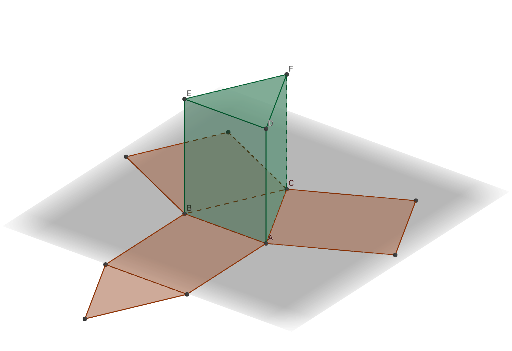
① This example demonstrates the net of a triangular prism, showing how a set of planar polygons can be folded to form a 3D prism. ② Core mathematical concepts include solid geometry, prism structure, nets and folding, correspondence between faces and edges, and transformation between 2D and 3D shapes. ③ Construction highlights: using GeoGebra commands Point, Polygon, Prism, and Net; objects include vertices A, B, C, D, E, F, faces faceABED, faceBCFE, faceACFD, faceDEF, and edges edgeAD, edgeBE, edgeCF, etc.; the unfolded net consists of triangles and quadrilaterals (e.g., faceGHI, faceGHKJ). ④ Suitable for middle or high school geometry classes, helping students visualize surface development and enhance spatial reasoning, also useful for interactive math exploration.
GeoGebra Commands & Parameters
Point(yAxis) → CPolygon(A, B, C) → poly1, c, a, bPrism(poly1, 5.150720418783416) → d, D, edgeCF, edgeDE, edgeEF, edgeDF, E, F, faceABED, faceBCFE, faceACFD, faceDEF, edgeAD, edgeBENet(d, e) → f, G, P, faceGHI, faceGHKJ, faceHIML, faceGINO, faceJKP, edgeGH, edgeHI, edgeGI, edgeGJ, H, edgeJK, edgeHK, edgeHL, edgeLM, edgeIM, edgeIN, edgeNO, edgeGO, edgeKP, edgeJP, I, J, K, L, M, N, O