
The House of Additions: Visualizing Addition with Geometric Construction
Loading the math board and drawing, please wait…
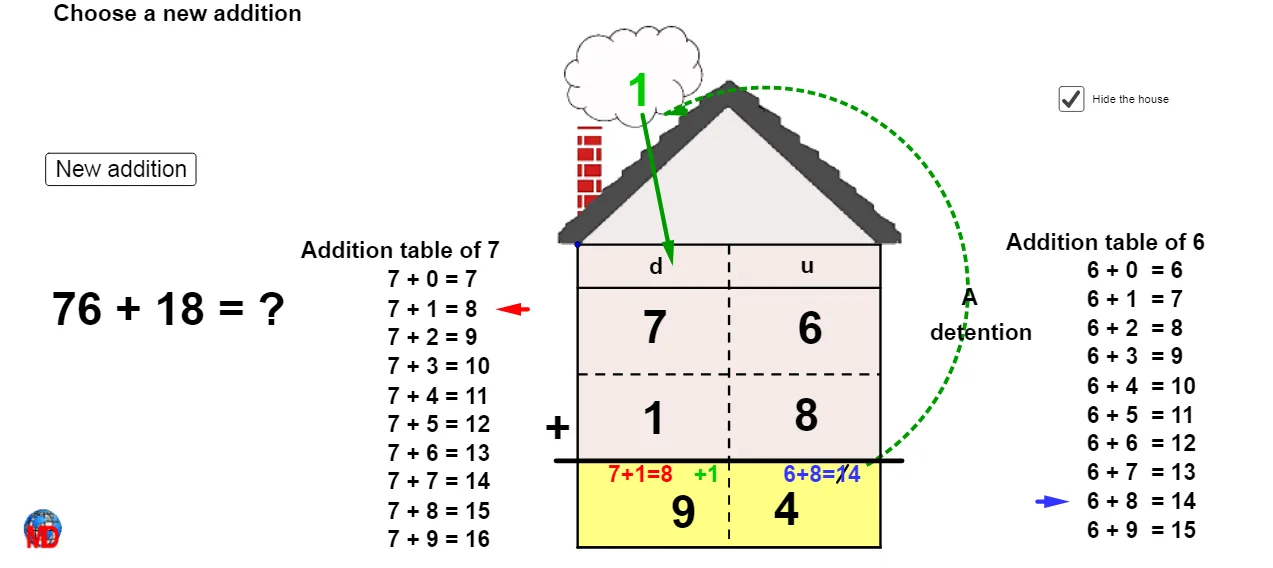
This GeoGebra example demonstrates addition operations through a playful 'house' composed of polygons, segments, and circular arcs. It integrates core mathematical concepts such as addition, arithmetic, step functions, linear functions, the unit circle, angles, and trapeziums, linking abstract numerical operations with concrete geometric representations. The construction uses commands like Polygon, Midpoint, Segment, Intersect, Random, If, CircumcircleArc, Vector, and Sequence, creating objects including images, points, polygons, segments, arcs, vectors, and text labels. Random values and conditional logic generate varied addition scenarios, making the learning interactive. Suitable for upper elementary and middle school students, as well as teachers seeking engaging visual aids for arithmetic lessons, this example helps learners grasp addition through spatial reasoning and dynamic geometry.
GeoGebra Commands & Parameters
Polygon(A, B, D, C) → poly1, a, b, d, cMidpoint(a) → EMidpoint(d) → FSegment(E, F) → eSegment(G, H) → fMidpoint(G, C) → IMidpoint(H, D) → J_2Segment(I, J_2) → gMidpoint(E, G) → K_1Midpoint((6.901818181818182, 5.7290909090909095), E) → LMidpoint(E, H) → MIntersect(g, e) → NRandom(0, 9) → bbRandom(0, 9) → ddRandom(1, 9) → aaRandom(1, 9) → ccMidpoint(G, N) → OMidpoint(N, C) → PMidpoint(N, D) → QMidpoint(H, N) → RMidpoint(F, T) → UMidpoint(F, S) → VIf(resu ≥ 10, resu - 10, resu) → res1Segment(Z, W) → hCircumcircleArc(A_1, B_1, C_1) → kVector(D_1, C_1) → uIf(resu ≥ 10, aa + cc + 1, aa + cc) → dizSegment(C, D) → iSegment(S, T) → jMidpoint(j) → E_1If(diz ≥ 10, diz - 10, diz) → diz1Polygon(C, S, T, D) → poly2, c_1, s, t, d_1Midpoint(j) → F_1Segment(F, F_1) → lSegment(C - (0.5, 0), D + (0.5, 0)) → mVector(G_1, H_1) → vSequence(K + (0, (-2 * i / 3)), i, 1, 10) → liste1Sequence(J + (0, (-2 * i / 3)), i, 1, 10) → liste2Sequence(Text[aa + (" + " * (i - 1)) + ((" = " * (aa + i - 1))), Element[liste2, i] - (0.75, 0)], i, 0, 11) → liste4Sequence(Text[bb + (" + " * (i - 1)) + ((" = " * (bb + i - 1))), Element[liste1, i] - (0.85, 0)], i, 0, 11) → liste3Vector(J_1 + (0.5, 0), J_1 - (0.25, 0)) → wVector(L_1, L_1 + (0.75, 0)) → z
AI Drawing Prompt Reference
Draw a geometric house structure for visualizing addition, consisting of polygon walls and door or window frames with arched tops. The main body is a quadrilateral divided into different sections by midpoints and line segments. Include numeric labels showing addition equations on the walls or door. The graphic contains circular arcs, vector arrows, and stepped elements arranged in sequence, demonstrating the progressive accumulation of addition operations. The entire composition should be colorful and clearly arranged, suitable as a visual teaching aid for arithmetic lessons.
The prompt above was compiled from the original drawing commands and is for reference only.