
Area Model for Multiplying Two-Digit by Two-Digit Numbers
Loading the math board and drawing, please wait…
In collections
Multiplication with Area Models
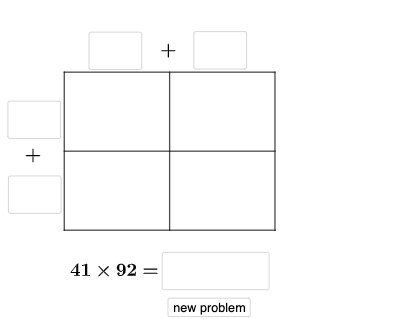
This example demonstrates how to multiply a two-digit number by another two-digit number using a flexible 2D area model (area partition). By decomposing each number into tens and ones, the multiplication is visualized as the sum of rectangle areas, making the distributive property and place-value structure tangible. Key concepts include the distributive law, tens–ones decomposition, and representing multiplication through geometric area. In GeoGebra, the construction relies on Intersect to place precise corner/partition points, Point to define those key vertices, Segment to draw partition edges, and Polygon to form the rectangular regions and the overall outline. The optional If logic supports conditional labeling or piecewise updates of displayed values, while Random provides varying two-digit inputs for dynamic exploration. Textfield is used to enter or show numeric parameters (e.g., variables corresponding to the factor counts per region such as q1, q2). The result is a manipulable diagram built from many constructed objects (points and segments) that correspond to the sub-rectangles in the area model. Suitable for upper primary through middle school, for classroom instruction, tutoring, and interactive learning with dynamic geometry software.
GeoGebra Commands & Parameters
Intersect(xAxis, yAxis) → APoint(yAxis) → DPoint(xAxis) → EPoint(xAxis) → FPoint(yAxis) → LPolygon(A, E, G, L) → q1, a_{2}, e, g_{4}, l_{2}Polygon(E, F, H, G) → q2, e_1, f_{2}, h_{4}, g_1Polygon(G, H, K, J) → q5, g_2, h_3, k_1, j_{2}Polygon(L, G, J, D) → q6, l_1, g_3, j_1, d_{2}Segment(D, A) → qSegment(J, E) → sSegment(K, F) → tRandom(1, 9) → oRandom(1, 9) → uRandom(1, 9) → vRandom(1, 9) → wRandom(1, 9) → a_1Random(1, 9) → b_1Textfield(d_1) → aTextfield(m_1) → bTextfield(t_1) → dTextfield(u_1) → fTextfield(o_1) → gTextfield(p_1) → hTextfield(r_1) → kTextfield(s_1) → lTextfield(ansguess) → nIf(n_1 ≟ v, "√", "X") → text3If(ansguess ≟ produc, "☺", "☹ ") → text7Segment(L, H) → rSegment(A, F) → m_{2}Segment(D, K) → pIf(d_1 + m_1 ≟ (10 * u) + v, "√", "X") → text2If(t_1 + u_1 ≟ (10 * w) + a_1, "√", "X") → text5
AI Drawing Prompt Reference
Create an area model diagram for multiplying two two-digit numbers using a flexible 2D partition of rectangles on a coordinate-axis layout. Start by defining key vertices from the intersection of the axes and several points chosen on the x-axis and y-axis. Use those points to form multiple rectangular regions by drawing polygons that correspond to tens–ones decomposition; include several polygons for the subdivided smaller rectangles and one polygon for the overall outline. Add partition edges with straight segments connecting the corresponding vertices so the big rectangle is clearly split into the sub-rectangles. Place value text in appropriate areas near region corners, and make the construction respond to dragging of the defining points so the partition updates dynamically.
The prompt above was compiled from the original drawing commands and is for reference only.