
The Elevator Problem
Loading the math board and drawing, please wait…
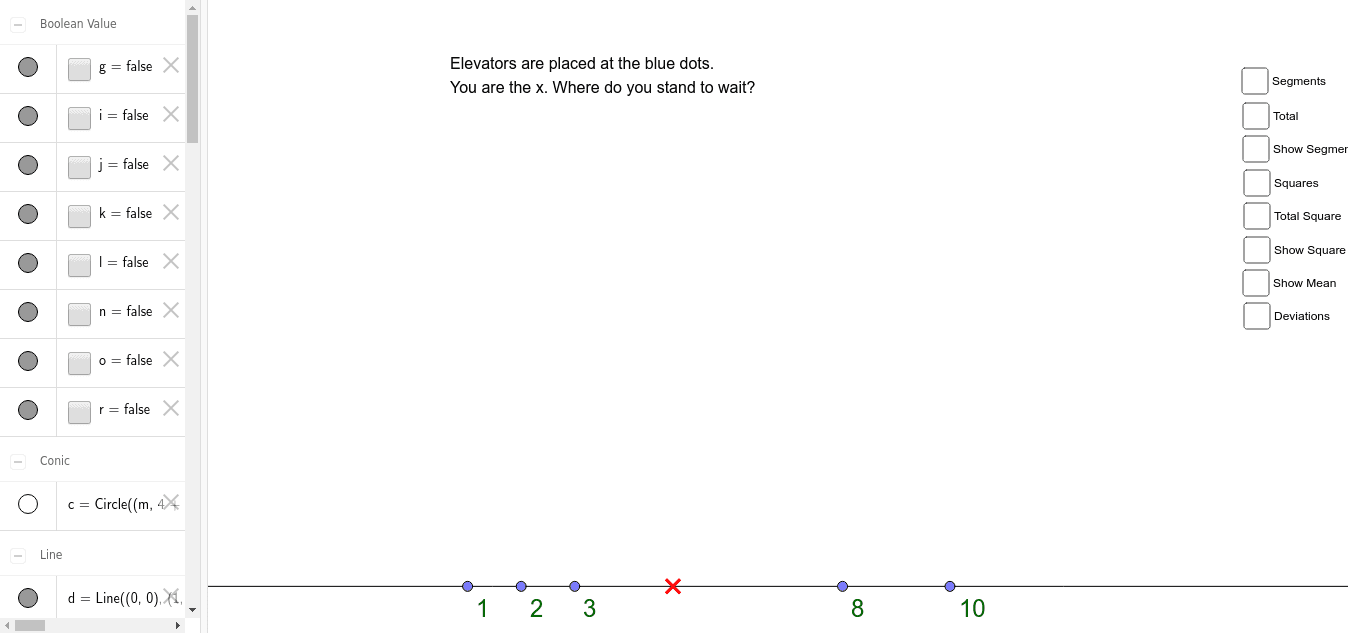
This example demonstrates the movement of an elevator between different floors. It involves key mathematical concepts such as functions, vectors, and loci. Using GeoGebra commands like Point, Vector, Sequence, and Polygon, the dynamic path of the elevator can be shown. Suitable for high school mathematics education, particularly in coordinate geometry and function graphing.
GeoGebra Commands & Parameters
Point(xAxis) → CPoint(xAxis) → GPoint(xAxis) → APoint(xAxis) → EPoint(xAxis) → DPoint(xAxis) → BVector((0, 0), (0, a)) → vSequence(Segment[Element[points, i] + (v * i), G + (v * i)], i, 1, 5) → list2Vector((0, 0), (0, b)) → wSequence(If[x(Element[points, i]) ≤ x(G), Polygon[Element[points, i] + (v * i), G + (v * i), 4], Polygon[G + (v * i), Element[points, i] + (v * i), 4]], i, 1, 5) → list4Vector((0, 0), F) → uSequence(Text[x(Element[points, i]), Element[points, i] + u], i, 1, Length[points]) → list1Line((0, 0), (1, 0)) → dLine((m, 4 + h), d) → eCircle((m, 4 + h), Sum[list2] / 2) → cIntersect(c, e) → H, IPolygon((m + s / 2, (-b)), (m - s / 2, (-b)), 4) → poly1Segment(H, I) → fSequence(If[x(Element[points, i]) > x(G), x(Element[points, i]) - x(G), 0], i, 1, 5) → aboveSequence(If[x(Element[points, i]) < x(G), x(G) - x(Element[points, i]), 0], i, 1, 5) → belowSum(above) → abvSum(below) → belSegment((x(A), -1.4), (x(A) + abv, -1.4)) → pSegment((x(A), -1.7), (x(A) + bel, -1.7)) → q