
The 6th Set of Nets: Rotating Equilateral-Triangle Constructions
Loading the math board and drawing, please wait…
In collections
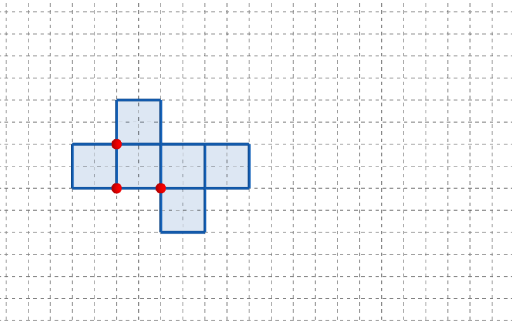
How many nets of a cuboid are there?
This example demonstrates the “6th Set of Nets” by constructing and visualizing a net-like geometric configuration generated from equilateral-triangle-related structures. By repeatedly applying rotations controlled by parameters, it reveals how the overall pattern evolves and what stable structure emerges. The key mathematical ideas include equilateral-triangle geometry, the rotation viewpoint that connects naturally with complex-number transformations, and—at a conceptual level—limit/optimization perspectives (e.g., linear programming or linear optimization) for reasoning about convergence or extremal behavior when parameters vary. Construction uses GeoGebra commands shown in the build summary: Point to define key vertices (e.g., A, B, C and parameter-driven points such as q1, q2, q4, q5, q6), Polygon to connect vertices into faces/boundaries, and Rotate to generate rotated counterparts (such as q2', q5', q6'_1). Interactive control is supported via sliders/parameters t and t' and buttons (button1, button2) to switch among configuration states. Suitable for high school to early university geometry, interactive construction practice, and STEM visualization activities focusing on transformation-driven patterns.
GeoGebra Commands & Parameters
Point(Ray[(1, 0), (3, 0)]) → APoint(Ray[A + (1, 0), A + (2, 0)]) → CPoint(Ray[A + (0, 1), A + (0, 2)]) → BPolygon({(0, 0), A, B, (0, y(B))}) → q1Polygon({A, C, (x(C), y(B)), B}) → q2Polygon({B, B + (0, l), B + (h, l), B + (h, 0)}) → q4Polygon({C, C + (l, 0), C + (l, w), C + (0, w)}) → q5Polygon({C + (l, 0), C + (l + h, 0), C + (l + h, w), C + (l, w)}) → q6Rotate(q2, (90° * t), Line[B, A]) → q2'Rotate(Rotate[q5, (90° * t), Line[C + (0, w), C]], (90° * t), Line[B, A]) → q5'Rotate(Rotate[Rotate[q6, (90° * t), Line[C + (l, w), C + (l, 0)]], (90° * t), Line[C + (0, w), C]], (90° * t), Line[B, A]) → q6'_{1}Polygon({C, C + (0, (-h)), C + (l, (-h)), C + (l, 0)}) → q3Rotate(Rotate[Rotate[q3, (90° * t), Line[C + (l, 0), C]], (90° * t), Line[C + (0, w), C]], (90° * t), Line[B, A]) → q3'Rotate(Rotate[q4, (90° * t), Line[B, B + (h, 0)]], (90° * t), Line[B, A]) → q4'
AI Drawing Prompt Reference
Draw a net-like geometric figure composed of equilateral triangles. The figure consists of multiple equilateral triangle faces connected by rotations controlled by a parameter t. The rotation axis is a line connecting specific vertices. The figure should illustrate equilateral triangle geometry and the connection between rotation perspective and complex number transformations. The construction order starts with basic equilateral triangles, then generates other faces through rotations, and finally forms a stable net pattern.
The prompt above was compiled from the original drawing commands and is for reference only.