
The 2nd Set of Nets
Loading the math board and drawing, please wait…
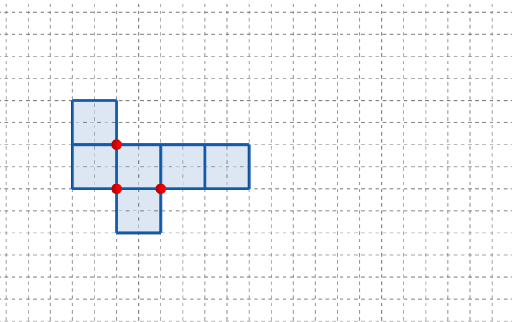
This example demonstrates the second set of nets in solid geometry. It involves the core mathematical concepts of unfolding and folding in solid geometry. Using GeoGebra commands such as Point, Polygon, and Rotate, the construction of the net of a solid figure is illustrated. Suitable for high school or university solid geometry courses.
GeoGebra Commands & Parameters
Point(Ray[(1, 0), (3, 0)]) → APoint(Ray[A + (1, 0), A + (2, 0)]) → CPoint(Ray[A + (0, 1), A + (0, 2)]) → BPolygon({(0, 0), A, B, (0, y(B))}) → q1Polygon({A, C, (x(C), y(B)), B}) → q2Polygon({B, B + (0, h), B + ((-l), h), B + ((-l), 0)}) → q4Polygon({C, C + (l, 0), C + (l, w), C + (0, w)}) → q5Polygon({C + (l, 0), C + (l + h, 0), C + (l + h, w), C + (l, w)}) → q6Rotate(q4, (90° * t), Line[(0, w), B]) → q4'Rotate(q2, (90° * t), Line[B, A]) → q2'Rotate(Rotate[q5, (90° * t), Line[C + (0, w), C]], (90° * t), Line[B, A]) → q5'Rotate(Rotate[Rotate[q6, (90° * t), Line[C + (l, w), C + (l, 0)]], (90° * t), Line[C + (0, w), C]], (90° * t), Line[B, A]) → q6'_{1}Polygon({A, C, C + (0, (-l)), A + (0, (-l))}) → q3Rotate(Rotate[q3, (90° * t), Line[C, A]], (90° * t), Line[B, A]) → q3'
AI Drawing Prompt Reference
Draw an unfolded net of a cube, consisting of a rectangle and several trapezoids. Start by drawing a rectangle and two adjacent trapezoids, then rotate one trapezoid by 90 degrees around one of the rectangle's sides, and continue rotating and flipping the trapezoids to form the net of a cube, demonstrating the concepts of unfolding and folding in solid geometry.
The prompt above was compiled from the original drawing commands and is for reference only.