
Thébault's Theorem: Equilateral Triangle from Square Centers
Loading the math board and drawing, please wait…
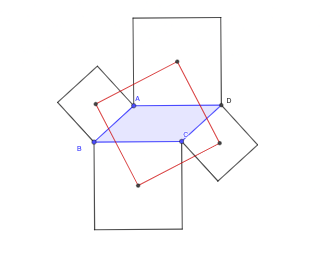
This GeoGebra demonstration illustrates Thébault's Theorem: constructing squares on each side of any triangle, the centers of these three squares always form an equilateral triangle. Key mathematical concepts include triangle properties, square construction, equilateral triangle characterization, and centroid computation. Construction uses Segment for triangle sides, Line for side extensions, Intersect to find square vertices, Polygon to build squares, and Centroid to locate each square's center. Ideal for high school geometry teaching, theorem proof exploration, and understanding similarity transformations in geometric reasoning.
GeoGebra Commands & Parameters
Segment(B, A) → fSegment(B, C) → gLine(C, f) → hLine(A, g) → iIntersect(h, i) → DPolygon(B, C, D, A) → q1, a, c, d, bPolygon(A, D, 4) → poly1, j, k, l, m, E, FPolygon(D, C, 4) → poly2, n, p, q, r, G, HPolygon(C, B, 4) → poly3, s, t, e, f_1, I, JPolygon(B, A, 4) → poly4, g_1, h_1, i_1, j_1, K, LCentroid(poly4) → MCentroid(poly1) → NCentroid(poly2) → OCentroid(poly3) → PPolygon(M, N, O, P) → q2, m_1, n_1, o, p_1Segment(L, B) → k_1Segment(L, K) → l_1Segment(K, A) → q_1Segment(F, A) → r_1Segment(F, E) → s_1Segment(E, D) → t_1Segment(D, H) → a_1Segment(H, G) → b_1Segment(G, C) → c_1Segment(J, C) → d_1Segment(B, I) → e_1Segment(I, J) → f_2Segment(M, P) → g_2Segment(P, O) → h_2Segment(O, N) → i_2Segment(N, M) → j_2
AI Drawing Prompt Reference
Draw an equilateral triangle formed by the centers of three squares constructed on the sides of any triangle. First, draw the triangle. Then, construct squares on each side. Next, find the centers of each square. Finally, connect these centers to form the equilateral triangle. The construction order is important to maintain the theorem's validity.
The prompt above was compiled from the original drawing commands and is for reference only.