
Temari Ball 4: 3D Decorative Sphere Construction Using Sequences and Surfaces
Loading the math board and drawing, please wait…
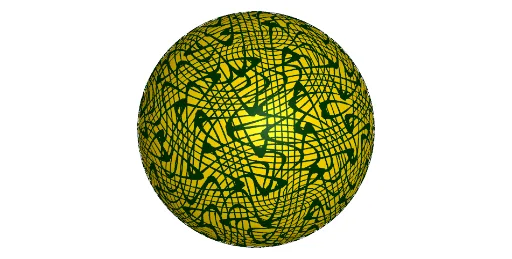
This GeoGebra example demonstrates Temari Ball 4, a three-dimensional decorative sphere inspired by traditional Japanese embroidered balls. It shows how patterns and surface patches can be distributed across a sphere using mathematical sequences and surface constructions. The core mathematical concepts include solid geometry (spheres, 3D solids, volume), sequences and series, intersections of geometric objects, and spatial correlation. The construction relies on GeoGebra commands Sphere, Surface, and Sequence, together with objects such as p, n, ep, a, image1, c, image2, l1, b, d, l2, and l3, to generate repeating arrangements on the spherical surface. This resource is suitable for high school solid geometry, university-level multivariable calculus or differential geometry introductions, and STEAM education projects that combine mathematics, art, and 3D modeling.
GeoGebra Commands & Parameters
Sphere((0, 0), 0.99) → aSurface((cos(k) * cos(a + sin((p * k)))), (cos(k) * sin(a + sin((p * k)))), sin(k), k, ((-π)) / 2, π / 2, a, 0, (ep * π / n)) → cSequence(Rotate[c, i, zAxis], i, 0, (2 * π), (2 * π / n)) → l1Surface((cos(k) * cos(a + sin((p * k)))), sin(k), (cos(k) * sin(a + sin((p * k)))), k, ((-π)) / 2, π / 2, a, 0, (ep * π / n)) → bSurface(sin(k), (cos(k) * sin(a + sin((p * k)))), (cos(k) * cos(a + sin((p * k)))), k, ((-π)) / 2, π / 2, a, 0, (ep * π / n)) → dSequence(Rotate[b, i, yAxis], i, 0, (2 * π), (2 * π / n)) → l2Sequence(Rotate[d, i, xAxis], i, 0, (2 * π), (2 * π / n)) → l3
AI Drawing Prompt Reference
Create a sphere of radius about 1 and cover its surface with three families of parametric patches: one family twists along latitude and is replicated n times around the z‑axis, a second twists along longitude and is replicated n times around the y‑axis, and a third twists along the other longitude and is replicated n times around the x‑axis; all patches share the same sinusoidal modulation parameter p and phase range ep·π/n, producing a three‑dimensional symmetric pattern reminiscent of a temari ball.
The prompt above was compiled from the original drawing commands and is for reference only.