
Temari Ball 2: Spherical Geometric Construction and Pattern Generation
Loading the math board and drawing, please wait…
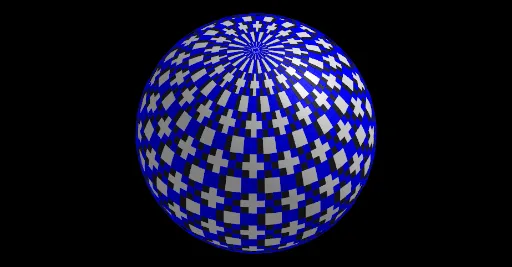
This GeoGebra example demonstrates the construction of a Temari ball, a traditional spherical embroidery design, using dynamic geometry commands. It shows how a sphere is created and partitioned into symmetric surface patterns through iterative point generation and joining operations. Core mathematical concepts include solid geometry (sphere, center O, radius R), geometric intersection, number sequences, rational numbers, and quadratic function relationships. The construction uses the Sphere command to generate the ball, the Sequence command to produce object lists such as liste1, liste3, and liste4, and the Join command to connect points and lines. Additional objects include points p, h_1, B_1, lines g and k, with Zoom applied for view control. Suitable for high school and university solid geometry courses, geometric construction labs, mathematical art projects, and GeoGebra scripting practice.
GeoGebra Commands & Parameters
Join(Sequence[Sequence[O + (((R * cos(i)) * cos(j)), ((R * cos(i)) * sin(j)), (h_1 * sin(i))), j, 0, 6.28319, π / n], i, 0, 6.28319, π / n]) → liste3Sphere(O, R - 0.1) → iSequence(Polygon[Element[liste3, i], Element[liste3, i + 1], Element[liste3, i + 1 + (2 * n) + e], Element[liste3, i + e + (2 * n)]], i, 1, Length[liste3], h) → liste1Sequence(Polygon[Element[liste3, i], Element[liste3, i - 1], Element[liste3, i - 1 + (2 * n) + e], Element[liste3, i + e + (2 * n)]], i, 1, Length[liste3], h) → liste4
AI Drawing Prompt Reference
Create a spherical surface centered at point O with radius R. Generate symmetric points on the sphere using two angular parameters (i and j), forming a closed set of surface positions, and then connect neighboring positions to build the main ring-like partition on the sphere. Next, use groups of vertices from this ring—taking adjacent points as well as points offset by a fixed index amount—to construct quadrilateral patches on the surface, repeating this process across the ring. Finally, mirror the same patch construction in the opposite direction to obtain a Temari-style pattern with strong spherical symmetry, and zoom in to emphasize the surface design details.
The prompt above was compiled from the original drawing commands and is for reference only.