
Tangent Identity Dynamically Illustrated
Loading the math board and drawing, please wait…
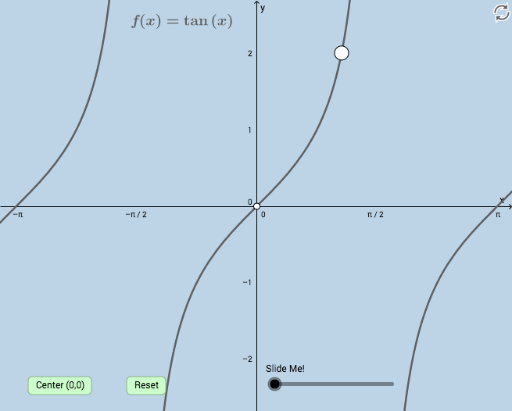
This example dynamically illustrates a special property of the Tangent function by constructing elements related to a right triangle to showcase the geometric meaning of the tangent value. It involves core mathematical concepts such as the Tangent function, right triangles, the ratio of the hypotenuse to the opposite side, and trigonometric identities. The construction utilizes GeoGebra commands like Mirror, Point, Intersect, Dilate, Segment, Rotate, Vector, and Translate. It is suitable for high school mathematics students and learners interested in the properties of trigonometric functions, providing an intuitive understanding of the geometric definition and properties of the tangent function.
GeoGebra Commands & Parameters
Mirror(g, x = 0) → g_1Point(g) → FIntersect(h, y = 0) → GMirror(G, x = 0) → G'Mirror(F, A) → F'Dilate(H, If[0 < e ≤ 1, 1 - e, 0], G) → H'Segment(H, H') → iDilate(G, If[1 < e ≤ 2, 2 - e, 0], F) → G'_1Segment(G, G'_1) → jRotate(H, If[2 < e ≤ 3, ((-(e - 2)) * π), (-π)], H) → H'_1Rotate(H', If[2 < e ≤ 3, ((-(e - 2)) * π), (-π)], H) → H''Segment(H'_1, H'') → i'Dilate(G', If[3 < e ≤ 4, 4 - e, 0], F') → G''Segment(G', G'') → kDilate(F, If[4 < e ≤ 5, 5 - e, 0], F') → F'_1Vector(F, F'_1) → uTranslate(G, u) → G'_2Translate(G'_1, u) → IMirror(g, A) → g_2Rotate(G, If[4 < e ≤ 5, ((-(e - 4)) * π), (-π)], G) → G'_3Rotate(G'_1, If[4 < e ≤ 5, ((-(e - 4)) * π), (-π)], G) → JSegment(G'_3, J) → j'Dilate(G, If[5 < e ≤ 6, 6 - e, 0], G') → G'_4Vector(G, G'_4) → vTranslate(G'_3, v) → KTranslate(J, v) → J'Segment(K, J') → j''
AI Drawing Prompt Reference
Draw a dynamic illustration of the tangent function's geometric meaning. Start with a horizontal and a vertical axis. Construct a right triangle with one leg on the horizontal axis and the hypotenuse forming an acute angle with it. Reflect this triangle across the vertical axis to create a symmetric counterpart. Place a moving point on the triangle and draw a segment parallel to the horizontal axis from that point to represent the tangent ratio. Then, by rotating and scaling, show how the ratio of the hypotenuse to the opposite side changes as the angle varies. Finally, use arrow vectors to translate segments and display the resulting shifted lines, demonstrating the periodicity and symmetry of the tangent function.
The prompt above was compiled from the original drawing commands and is for reference only.