
Symmetry on Overlapping Ellipses
Loading the math board and drawing, please wait…
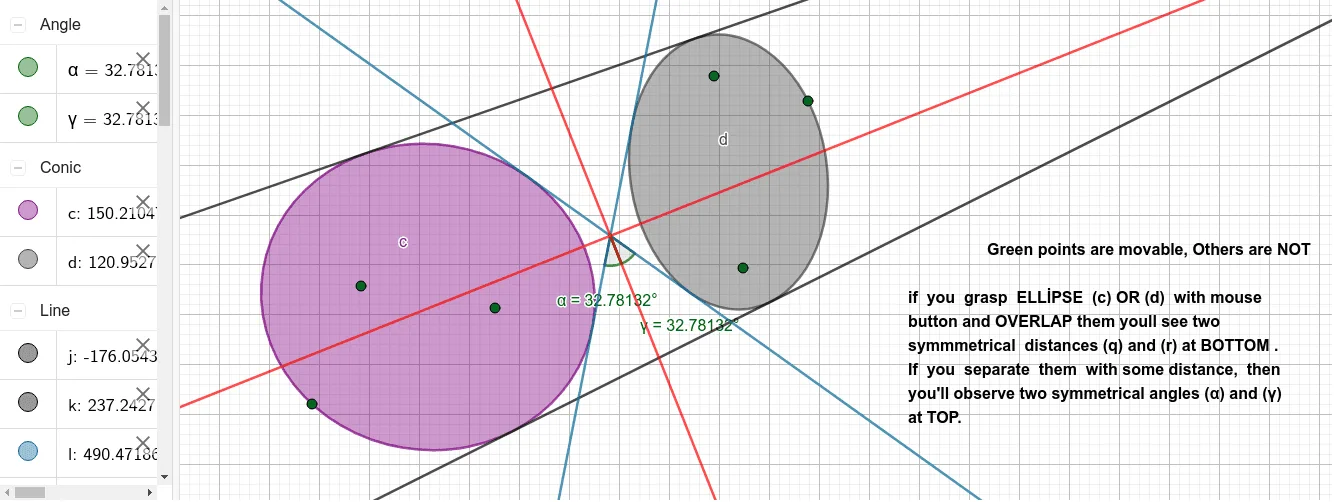
① This example demonstrates the symmetry properties of two overlapping ellipses through their intersection points, tangents, and auxiliary lines. ② Core mathematical concepts include the definition and properties of ellipses, symmetry, geometric transformations (reflection and rotation), and relationships among quadrilaterals, angle bisectors, perpendicular bisectors, and other geometric elements derived from the ellipse intersections. ③ Construction highlights: using GeoGebra commands such as Ellipse, Intersect, OrthogonalLine, Midpoint, LineBisector, Line, Tangent, AngularBisector, Segment, PointIn, and Angle to build perpendiculars, midpoints, bisectors, tangents, and angle markers, forming a complete diagram for symmetry analysis. ④ Suitable for high school and above students or teachers in analytic geometry, geometric transformations, and symmetry topics, as well as for deeper exploration of ellipse properties in math competitions.
GeoGebra Commands & Parameters
Ellipse(A, B, C) → cEllipse(D, E, F) → dIntersect(c, d) → G, H, J, KOrthogonalLine(H, xAxis) → fOrthogonalLine(G, xAxis) → gMidpoint(H, G) → ILineBisector(G, H) → iLine(G, H) → hTangent(c, d) → j, k, l, mIntersect(-1578.5927185225794x² - 1853.7406890715413x y + 30.958453820744126y² + 21386.95892336209x + 7095.754993324492y = 58860.251128762924, c) → , , ,AngularBisector(m, l) → n, pSegment(I, G) → qSegment(I, H) → rPointIn(d) → PointdPointIn(c) → PointcAngle(n, m) → αAngle(l, n) → γ
AI Drawing Prompt Reference
Draw two ellipses c and d that intersect at points G, H, J, and K. Construct perpendicular lines f and g through points H and G to the x-axis, find the midpoint I of H and G, and draw the angle bisector i. Then, draw the line h through H and G, and the tangents j, k, l, and m to the ellipses c and d. Find the angle bisectors n and p of tangents m and l, connect I and G, and I and H to form segments q and r, and select points Pointd and Pointc on ellipses d and c respectively, and measure the angle α between n and m.
The prompt above was compiled from the original drawing commands and is for reference only.