
Symmetry-and-Mirror Construction of a Hyperbola with Perimeter-Type Features
Loading the math board and drawing, please wait…
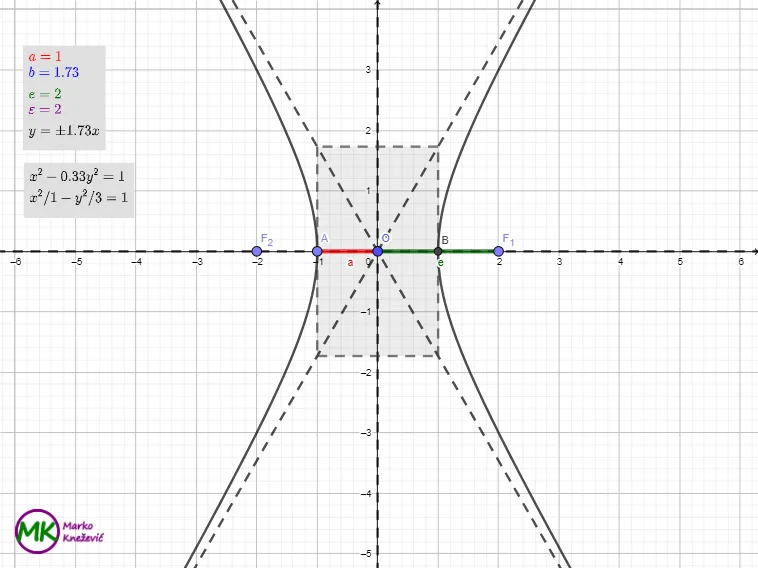
This example demonstrates how to construct a hyperbola in a dynamic geometry setting by combining symmetry and mirror relationships, along with its asymptotes. It also links geometric measurements such as distances (and hence perimeter- or constraint-like quantities) to the drawn figure. The key concepts include the geometric definition of a hyperbola via focal distance properties, symmetry/reflective transformation (Mirror), asymptotes (Asymptote), and coordinate-geometry tools like line construction, orthogonal lines, and slope (Line, OrthogonalLine, Slope). Construction highlights: from the GeoGebra command set, it uses Line, Point, OrthogonalLine, and Mirror to establish baseline geometry and reflected points; then Hyperbola and Asymptote to generate the hyperbola and its asymptotes; Intersect to locate crucial intersection points; Polygon and Segment to form and display the polygonal structure; and Distance and Slope to measure and label the relevant quantities. It is well-suited for advanced secondary students and early undergraduate learners studying hyperbola properties, geometric transformations, and measurement-driven problem solving.
GeoGebra Commands & Parameters
Line(O, xAxis) → largeAxisPoint(largeAxis) → AOrthogonalLine(A, largeAxis) → iPoint(largeAxis) → F_1Mirror(F_1, O) → F_2Hyperbola(F_2, F_1, A) → cAsymptote(c) → f, gIntersect(f, i) → FIntersect(g, i) → EIntersect(c, largeAxis, 2) → BOrthogonalLine(B, largeAxis) → hIntersect(f, h) → HIntersect(g, h) → GPolygon(E, F, G, H) → q1, e_1, f_1, g_1, h_1Line(O, yAxis) → smallAxisIntersect(c, smallAxis, 2) → CIntersect(c, smallAxis, 1) → DSegment(A, O) → aSegment(O, F_1) → eDistance(O, h_1) → bSlope(f) → slope
AI Drawing Prompt Reference
Draw a hyperbola using symmetry and mirroring. Start by drawing a large axis, then take point A on the axis and draw a perpendicular line i. Next, take focus F1 on the axis and find its mirror F2 about the origin. Construct the hyperbola c using F2, F1, and A. Then, draw the asymptotes f and g of the hyperbola, find their intersections with i at points F and E, the second intersection of c with the large axis at B, draw a perpendicular line h from B, and find its intersections with f and g at H and G, respectively. Finally, construct a polygon q1 using points F, E, G, and H.
The prompt above was compiled from the original drawing commands and is for reference only.