
Symmedian in a Cyclic Quadrilateral
Loading the math board and drawing, please wait…
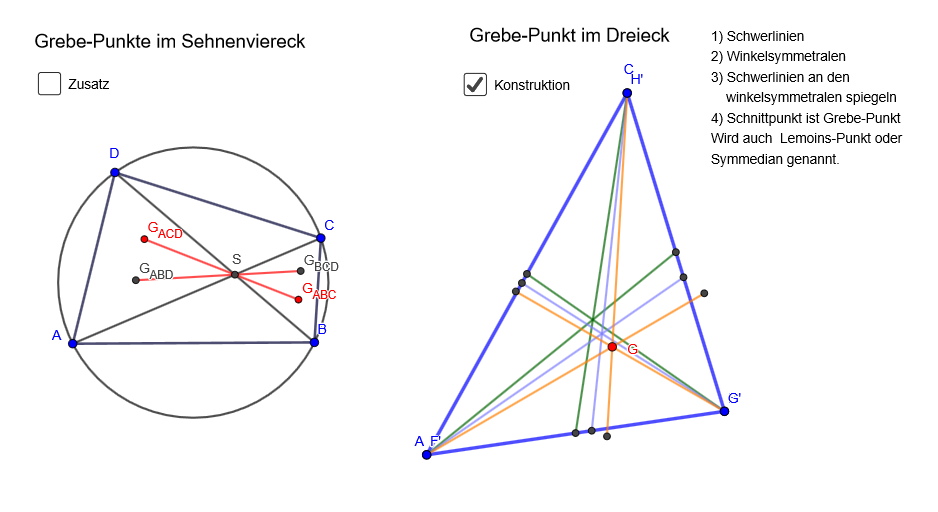
This example demonstrates the properties of symmedians in a cyclic quadrilateral. Key mathematical concepts include angle bisectors, midlines, and similar triangles. Using GeoGebra commands such as Circle, Polygon, Intersect, and AngularBisector, one can construct a cyclic quadrilateral and its symmedian. Suitable for students at the middle school level and above for geometric construction.
GeoGebra Commands & Parameters
Circle(A, B, C) → ePoint(e) → DPolygon(A, B, C, D) → v1, a, b, c, dSegment(D, B) → fSegment(A, C) → gIntersect(f, g) → SGrebePunkt(A, B, C) → G_{ABC}GrebePunkt(A, C, D) → G_{ACD}Segment(G_{ACD}, G_{ABC}) → hGrebePunkt(A, B, D) → G_{ABD}GrebePunkt(B, C, D) → G_{BCD}Segment(G_{ABD}, G_{BCD}) → iPolygon(F, G_{1}, H) → d1, h_1, f_1, g_1Midpoint(g_1) → IMidpoint(f_1) → JMidpoint(h_1) → KSegment(H, K) → jSegment(F, J) → kSegment(I, G_{1}) → lAngularBisector(G_{1}, F, H) → mAngularBisector(H, G_{1}, F) → nAngularBisector(F, H, G_{1}) → pIntersect(n, g_1) → LIntersect(m, f_1) → MIntersect(p, h_1) → NSegment(H, N) → qSegment(F, M) → rSegment(G_{1}, L) → sMirror(I, s) → I'Mirror(G_{1}, s) → G'Segment(I', G') → l'Mirror(H, q) → H'Mirror(K, q) → K'Segment(H', K') → j'Mirror(F, r) → F'Mirror(J, r) → J'Segment(F', J') → k'Intersect(l', j') → GTangent(D, e) → t,Tangent(C, e) → i_1,Tangent(B, e) → j_1,Tangent(A, e) → k_1,Intersect(t, k_1) → EIntersect(t, i_1) → OIntersect(i_1, j_1) → PIntersect(j_1, k_1) → QSegment(O, Q) → l_1Segment(E, P) → m_1Segment(E, Q) → n_1Segment(Q, P) → p_1Segment(P, O) → q_1Segment(E, O) → r_1
AI Drawing Prompt Reference
On a single circle choose points A, B, C, and take another point D on the same circle to form the cyclic quadrilateral A–B–C–D. Connect A to C and B to D, and mark their intersection. Then construct angle-bisector based lines associated with the triangles formed by A, B, C and by A, C, D, and similarly for the triangles A, B, D and B, C, D. Intersect these bisector lines with the relevant chords to obtain several key intersection points, and join them to the corresponding vertices to form the main connecting segments. Use midpoint-derived points and reflect them across a selected segment to produce mirrored key points, creating a symmetric configuration. Finally, draw tangents from the circle at the appropriate vertices, take the intersections of the tangents, and connect the resulting intersection points with the previously obtained key points to emphasize the final segment relations.
The prompt above was compiled from the original drawing commands and is for reference only.