
Sylvester's Four-Point Problem
Loading the math board and drawing, please wait…
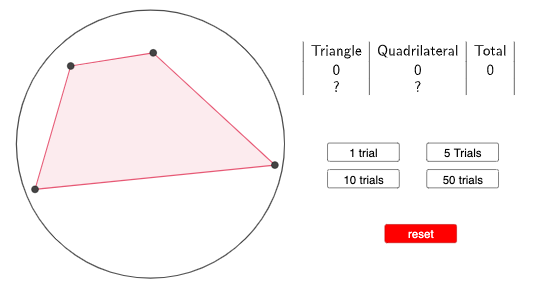
This example demonstrates Sylvester's Four-Point Problem, which involves selecting four random points within a quadrilateral and examining the distribution of the intersection of the diagonals of the quadrilateral formed by these points. Key mathematical concepts include probability and geometric construction. Using GeoGebra commands such as Intersect, Circle, RandomPointIn, and ConvexHull, the example dynamically shows the random selection of four points and the distribution of the intersection of the diagonals. Suitable for high school mathematics education and research.
GeoGebra Commands & Parameters
Intersect(xAxis, yAxis) → ACircle(A, 1) → cRandomPointIn(c) → BRandomPointIn(c) → CRandomPointIn(c) → DRandomPointIn(c) → EConvexHull({B, C, D, E}) → graph1Sum(Q) → bLength(Q) → dTableText({"Triangle", "Quadrilateral", "Total"}, {b, d - b, d}, {e, f}, "c|h") → text1
AI Drawing Prompt Reference
Randomly select four points within a unit circle and draw the convex quadrilateral formed by these points, observing the distribution of the intersection points of its diagonals. Start by plotting the intersection of the coordinate axes, then draw a unit circle centered at this point. Randomly generate four points inside the circle, connect them to form a convex quadrilateral, and finally display the intersection points of the diagonals and their distribution, along with a count of triangles and quadrilaterals.
The prompt above was compiled from the original drawing commands and is for reference only.