
Supplementary Angles Meaning
Loading the math board and drawing, please wait…
In collections
Congruence (CO) Cluster
Congruence (Vol 1)
Congruence (Vol 1) Over 80 Resources
CCSS High School: Geometry (Congruence) Volume 1 S N ATTAR
Geometry (Congruence) Volume 1
CCSS High School: Geometry (Congruence) Volume 1
CCSS High School: Geometry (Congruence) Volume 1
CCSS High School: Geometry (Congruence) Volume 1
CCSS High School: Geometry (Congruence) Volume 1
CCSS High School: Geometry (Congruence) Volume 1
CCSS High School: Geometry (Congruence) Volume 1
CCSS High School: Geometry (Congruence) Volume 1
CCSS High School: Geometry (Congruence) Volume 1
CCSS High School: Geometry (Congruence) Volume 1
CCSS High School: Geometry (Congruence) Volume 1
CCSS High School: Geometry (Congruence) Volume 1
CCSS High School: Geometry (Congruence) Volume 1
Geometry: Introductory Definitions, Postulates, Theorems
Congruence: Volume 1 - Chapter 1
Congruence: Volume 1 - Chapter 1
Intro to Angles
Year 9 Mathematics
Year 7 (Angles)
Introduction to Angles
Explore Angles Relationships
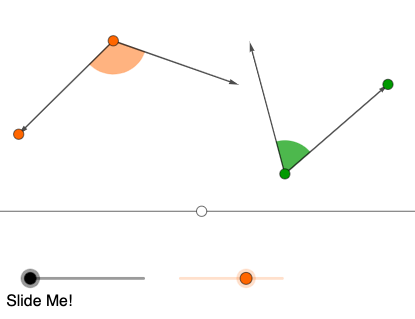
This example illustrates the meaning of supplementary angles, which are two angles that add up to 180 degrees. Using various GeoGebra commands such as constructing lines, rotating, and translating, the example provides a visual demonstration of supplementary angles. Suitable for middle and high school students learning geometry.
GeoGebra Commands & Parameters
OrthogonalLine(E, f) → iAngle(i, f) → βRay(F, G) → nCircle(F, 2) → pIntersect(p, n, 1) → HRotate(H, α, F) → H'CircleSector(F, H, H') → qRay(F, H') → rRay(I, J) → sCircle(I, 2) → tIntersect(t, s, 1) → KRotate(K, pi - α, I) → K'Ray(I, K') → bCircleSector(I, K, K') → c_1Line(E, s) → gPoint(f) → APoint(g) → BAngle(A, E, B) → γDilate(I, If[0 < a ≤ 1, 1 - a, 0], E) → I'Vector(I, I') → uTranslate(c_1, u) → cRotate(c, If[0 < a ≤ 1, (a * ((2 * pi) - γ)), (2 * pi) - γ], I') → c'Point(r) → DRotate(M, pi - α, E) → M'Ray(E, M') → kPoint(r) → CAngle(C, F, L) → δDilate(F, If[1 < a ≤ 2, 2 - a, 0], E) → F'Vector(F, F') → vTranslate(q, v) → q'Rotate(q', If[1 < a ≤ 2, ((a - 1) * δ), δ], F') → q''Circle(F, G) → dCircle(I, J) → eIntersect(e, b, 1) → NIntersect(d, r) → O,Vector(F, G) → wVector(F, O) → jVector(I, J) → lVector(I, N) → mRotate(f, pi / 2 - α, E) → f'
AI Drawing Prompt Reference
Draw two supplementary angles with angles α and 180°-α. Start by drawing a line EF, then take point F on EF and draw a circle with center F, intersecting ray FG at point H. Rotate point H around F by α degrees to get H'. Draw a sector FHH' with central angle α, and draw ray FH'. On ray FG, take point I and draw a circle with center I, intersecting ray IH' at point K. Rotate point K around I by 180°-α degrees to get K', draw ray IK', and draw a sector IKK' with central angle 180°-α. Draw line EF, intersecting ray FG at points A and B, and calculate the angle ∠EAB as γ. Then take point I' such that vector II' is parallel to vector IE, and translate sector IKK' along vector II' to get sector I'K'K''. Finally, draw line EF, intersecting ray FG at point M, and rotate point M around E by 180°-α degrees to get M', and draw ray EM'.
The prompt above was compiled from the original drawing commands and is for reference only.