
Sum of Two Vectors Using Parallelogram Method
Loading the math board and drawing, please wait…
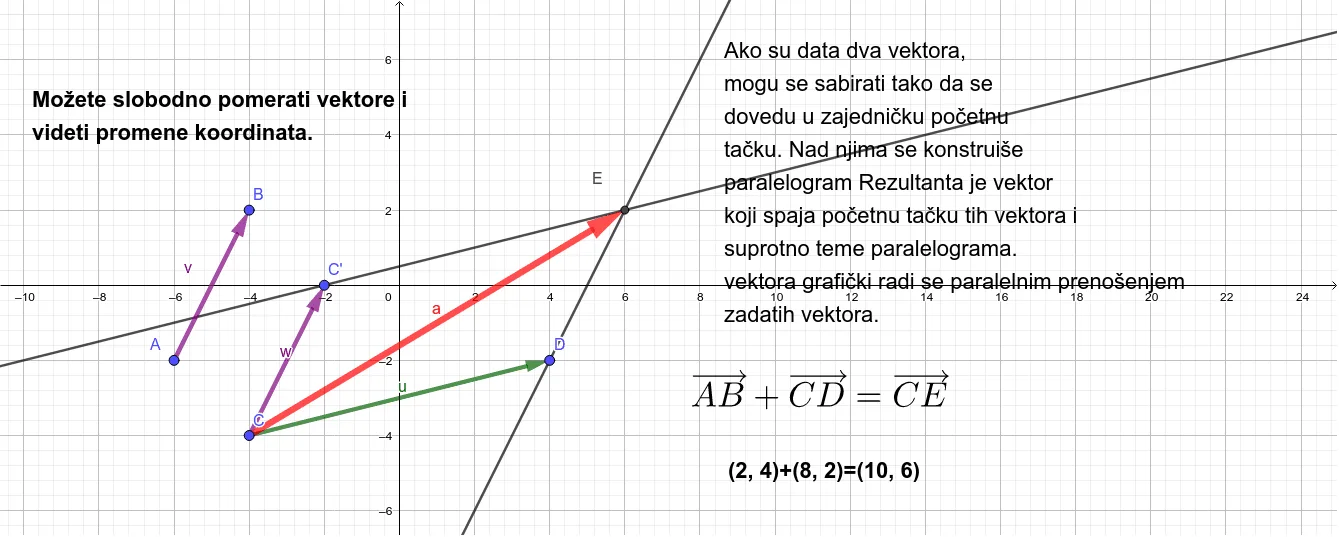
This example demonstrates how to find the sum of two 2D vectors using the parallelogram method. Key mathematical concepts include vector addition. The construction uses commands such as Vector, Translate, Line, and Intersect. Suitable for students in middle school and above to learn about vector addition.
GeoGebra Commands & Parameters
Vector(C, D) → uVector(A, B) → vTranslate(C, v) → C'Vector(C, C') → wLine(C', u) → fLine(D, w) → gIntersect(g, f) → EVector(C, E) → a
AI Drawing Prompt Reference
Draw a parallelogram to demonstrate the addition of two 2D vectors, start by plotting two vectors, then translate the second vector to the starting point of the first vector, draw a line from the starting point of the first vector to the endpoint of this translation, and another line from the endpoint of the second vector to the endpoint of the translation, the intersection of these two lines forms a parallelogram, the diagonal from the starting point of the first vector to this intersection point represents the sum of the two vectors.
The prompt above was compiled from the original drawing commands and is for reference only.