
Sum of Squares
Loading the math board and drawing, please wait…
In collections
geometriadinamica.es
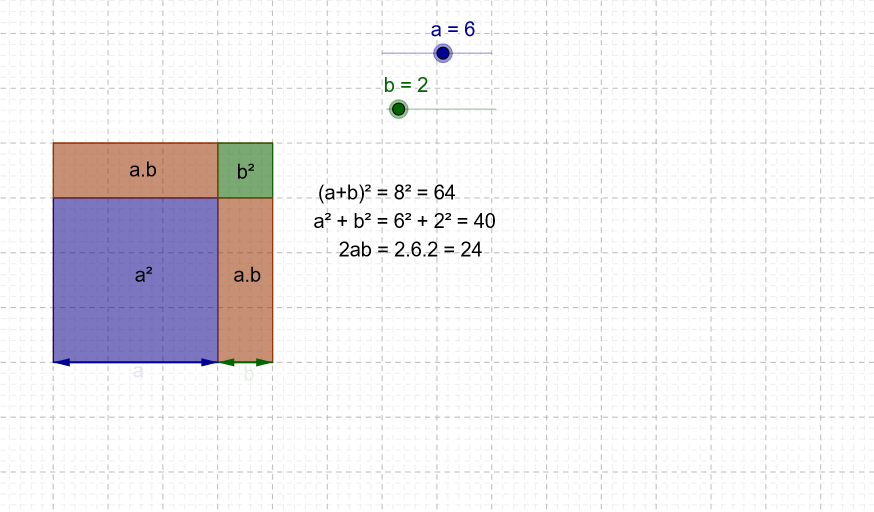
This example demonstrates the geometric representation of the square of the sum of vectors a and b. It involves core mathematical concepts like vector addition, polygon construction, and coordinate geometry. Key GeoGebra commands used include Vector and Polygon. Suitable for high school mathematics learning to understand vector operations and their geometric relationships.
GeoGebra Commands & Parameters
Vector(A, B) → uVector(C, B) → zVector(B, C) → wVector(B, A) → vPolygon(A, C, I, E) → T, a_2, c_1, i_1, e_1Polygon(A, B, F, D) → P, a_1, b_1, f, dPolygon(F, G, I, H) → R, f_2, g_1, i, hPolygon(B, C, G, F) → Q, b_2, c, g, f_1Polygon(F, H, E, D) → S, f_3, h_1, e, d_1
AI Drawing Prompt Reference
Draw a geometric figure illustrating the square of the sum of two vectors. Start with two vectors sharing a common origin, then construct their sum vector to form a parallelogram. Around this parallelogram, build five squares on its sides, each sharing a side with the parallelogram, ensuring adjacent squares share edges. The final diagram shows the geometric interpretation of vector addition and squared lengths, with clear vertices, edges, and filled regions.
The prompt above was compiled from the original drawing commands and is for reference only.