
Sum of Red and Blue Angles
Loading the math board and drawing, please wait…
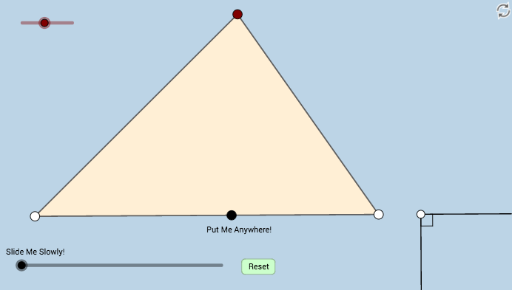
This example demonstrates the sum of the measures of the red and blue angles. The core mathematical concepts involved are angle measurement. Using GeoGebra commands such as Segment, Rotate, Ray, etc., specific geometric shapes can be constructed. Suitable for students at the junior high school level and above to learn about angle-related knowledge.
GeoGebra Commands & Parameters
Segment(B, A) → iRotate(A, (a * π / 180), B) → A'Ray(B, A') → gPoint(g) → CCircle(C, 2) → eLine(A, C) → lIntersect(e, l, 2) → ERay(C, E) → mSegment(B, C) → jAngle(C, A, B) → εRotate(C, ε / 2, A) → C'Ray(A, C') → n_1Segment(C, A) → hPoint(h) → DAngle(B, D, A) → ζRotate(B, ζ / 2, D) → B'_1Ray(D, B'_1) → a_1Intersect(n_1, a_1) → KOrthogonalLine(K, i) → cIntersect(c, i) → MCircle(K, M) → c_1Angle(C, D, B) → λRotate(C, λ / 2, D) → C'_1Ray(D, C'_1) → h_2Angle(B, C, A) → κRotate(B, κ / 2, C) → B'_2Ray(C, B'_2) → g_2Intersect(h_2, g_2) → LOrthogonalLine(L, j) → dIntersect(d, j) → NCircle(L, N) → k_2Min(Radius[c_1], Radius[k_2]) → o_1Circle(C, (0.6 * o_1)) → d_4Intersect(d_4, m, 1) → L_1Circle(L_1, 1) → e_4Intersect(e_4, m, 1) → M_1Ray(L_1, M_1) → j_3OrthogonalLine(L, h) → b_2Intersect(b_2, h) → POrthogonalLine(K, h) → a_2Intersect(h, a_2) → OAngle(A, B, A') → αRay(B, A) → fSegment(B, D) → kCircle(A, 2) → pPoint(j_3) → GOrthogonalLine(G, m) → nPoint(n) → FCircle(G, 2) → qIntersect(q, m, 2) → HIntersect(q, n) → I, JAngle(I, G, H) → βSegment(A, K) → rSegment(B, K) → sSegment(B, L) → tSegment(L, C) → bDilate(B, If[0 < u ≤ 1, 1 - u, 0], D) → B'Segment(B, B') → g_1Angle(D, A, K) → γSegment(D, K) → h_1Angle(B, D, K) → δMin(r, h_1) → vCircle(A, (0.3 * v)) → k_1Circle(D, (0.3 * v)) → p_1Intersect(k_1, h, 1) → QIntersect(k_1, r, 1) → RIntersect(p_1, h_1) → T,Intersect(p_1, k) → S,CircleSector(A, Q, R) → q_1CircleSector(D, S, T) → r_1Dilate(D, If[1 < u ≤ 2, 2 - u, 0], K) → D'Dilate(A, If[1 < u ≤ 2, 2 - u, 0], K) → A'_1Segment(A, A'_1) → i_1Segment(D, D') → j_1Segment(D, L) → l_1Segment(C, L) → m_1Min(m_1, l_1) → wCircle(C, (0.5 * w)) → s_1Intersect(s_1, j, 1) → UIntersect(s_1, m_1, 1) → VCircle(D, (0.5 * w)) → t_1Intersect(t_1, h) → W, ZIntersect(t_1, l_1) → A_1,CircleSector(D, W, A_1) → c_2CircleSector(C, U, V) → d_2Angle(C, A, C') → ηAngle(B, D, B'_1) → θSegment(A, K) → f_1Segment(D, K) → b_1Dilate(K, If[2 < u ≤ 3, 3 - u, 0], O) → K'Segment(K, K') → d_1Rotate(q_1, If[3 < u ≤ 4, ((u - 3) * γ), γ], A) → e_1Rotate(r_1, If[4 < u ≤ 5, ((u - 4) * δ), δ], D) → e_2Rotate(M, If[5 < u ≤ 7, ((u - 5) * π), (2 * π)], K) → M'CircleArc(K, M, M') → f_2Angle(B, C, B'_2) → μAngle(C, D, C'_1) → νDilate(D, If[7 < u ≤ 8, 8 - u, 0], L) → D'_1Dilate(C, If[7 < u ≤ 8, 8 - u, 0], L) → C'_2Segment(D, D'_1) → i_2Segment(C, C'_2) → j_2Dilate(L, If[8 < u ≤ 9, 9 - u, 0], P) → L'Segment(L, L') → l_2Rotate(c_2, If[9 < u ≤ 10, ((u - 9) * λ / 2), λ / 2], D) → p_2Rotate(d_2, If[10 < u ≤ 11, ((u - 10) * κ / 2), κ / 2], C) → q_2Rotate(N, If[11 < u ≤ 13, ((u - 11) * π), (2 * π)], L) → N'CircleArc(L, N, N') → r_2Dilate(B, If[13 < u ≤ 14, 14 - u, 0], K) → B'_3Segment(B, K) → m_2Segment(B, L) → n_2Min(m_2, n_2) → oCircle(K, (0.6 * o_1)) → s_2Circle(L, (0.6 * o_1)) → t_2Angle(K, O, A) → οAngle(C, P, L) → ιIntersect(s_2, m_2, 1) → B_1Intersect(s_2, i_1, 1) → C_1CircleSector(K, B_1, C_1) → c_3Intersect(t_2, j_2, 1) → D_1Intersect(t_2, n_2, 1) → E_1CircleSector(L, D_1, E_1) → d_3Segment(B, B'_3) → f_3Dilate(B, If[13 < u ≤ 14, 14 - u, 0], L) → B'_4Segment(B, B'_4) → g_3Angle(B_1, K, C_1) → ξAngle(E_1, L, D_1) → ρRotate(B_1, If[14 < u ≤ 15, ((u - 14) * ξ), ξ], K) → F_1CircleSector(K, B_1, F_1) → e_3Rotate(E_1, If[14 < u ≤ 15, ((-(u - 14)) * ρ), (-ρ)], L) → G_1CircleSector(L, G_1, E_1) → h_3Point(n) → I_1Dilate(K, If[15.5 < u ≤ 16.5, 16.5 - u, 0], G) → K'_1Vector(K, K'_1) → u_1Translate(c_3, u_1) → k_3Line(G, i_1) → i_3Point(i_3) → H_1Angle(H_1, G, I_1) → σRotate(k_3, If[16.5 < u ≤ 17.5, ((u - 16.5) * σ), σ], G) → p_3CircleArc(K, B_1, C_1) → q_3Circle(G, (0.6 * o_1)) → r_3Intersect(r_3, n, 2) → K_1Circle(K_1, (0.6 * o_1)) → s_3Intersect(s_3, n, 2) → J_1Dilate(L, If[17.5 < u ≤ 18.5, 18.5 - u, 0], J_1) → L'_1Vector(L, L'_1) → v_1Translate(d_3, v_1) → t_3CircleArc(L, D_1, E_1) → c_4Ray(C, L_1) → l_3Line(J_1, j_2) → m_3Rotate(B, ρ, K) → B'_5Rotate(B'_3, ρ, K) → N_1Rotate(B, σ, K) → B'_6Rotate(B'_3, σ, K) → O_1Segment(B'_6, O_1) → n_3Line(J_1, n_3) → a_3Point(a_3) → P_1Line(J_1, g_3) → b_3Point(b_3) → Q_1Angle(Q_1, J_1, P_1) → τRotate(t_3, If[18.5 < u ≤ 19.5, ((u - 18.5) * τ), τ], J_1) → f_4Dilate(J_1, If[19.5 < u ≤ 20.5, 20.5 - u, 0], G) → R_1Vector(J_1, R_1) → w_1Translate(f_4, w_1) → g_4Point(n) → S_1Ray(G, S_1) → h_4Line(C, G) → i_4Point(i_4) → T_1Ray(G, T_1) → j_4Polygon(A, C, B) → poly1, b_4, a_4, c_5Point(h_4) → U_1Point(j_4) → V_1Angle(U_1, G, V_1) → υ
AI Drawing Prompt Reference
Draw a triangle ABC with points A, B, and C at different positions. Use rotations and angle constructions to find points D, E, F, G, H, and I, ensuring that angles α, ε, ζ, λ, κ, M, N, O, and P meet specific conditions. Finally, construct two circles d_4 and e_4, along with some auxiliary segments and rays, ensuring they are perpendicular or intersect at specific points.
The prompt above was compiled from the original drawing commands and is for reference only.