
Sum of Interior Angles of a Triangle
Loading the math board and drawing, please wait…
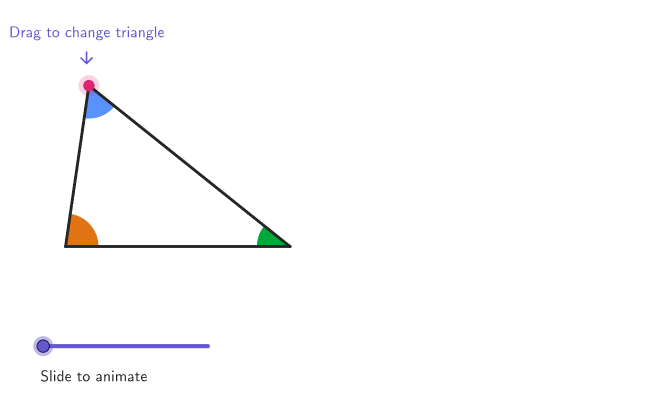
Explore how to find the sum of angle measures in any triangle with this interactive activity. The core math concept involves the triangle angle sum theorem. It uses GeoGebra commands like Intersect, Vector, Point, Polygon, PointIn, Translate, Rotate, Angle, Vertex, Segment, Circle, Line, Ray, circlePixels. Suitable for students in grades 6-8 to investigate and understand the properties of interior angles in polygons.
GeoGebra Commands & Parameters
Intersect(xAxis, yAxis) → BVector(B, (6, 0)) → transVecPoint(xAxis) → APolygon({(-7, 0), (-7, 6), (1, 6), (1, 0)}) → vertRectPointIn(vertRect) → CPolygon(A, B, C) → givenTri, c, a, bIntersect(p, a) → ETranslate(B, Vector[If[aniSli ≤ 1, Vector[(aniSli * transVec)], transVec]]) → B'Translate(C, Vector[If[aniSli ≤ 1, Vector[(aniSli * transVec)], transVec]]) → C'Translate(A, Vector[If[aniSli ≤ 1, Vector[(aniSli * transVec)], transVec]]) → A'Polygon(A', B', C') → transTri, c', a', b'Rotate(B, 90°, C) → B'_{1}Rotate(C, 90°, C) → C'_{1}Polygon(Rotate[A, (180° * If[1 ≤ aniSli ≤ 2, aniSli - 1, aniSli > 2, 1, 0]), E], Rotate[B, (180° * If[1 ≤ aniSli ≤ 2, aniSli - 1, aniSli > 2, 1, 0]), E], Rotate[C, (180° * If[1 ≤ aniSli ≤ 2, aniSli - 1, aniSli > 2, 1, 0]), E]) → rotTri, g, h, iIntersect(p, b) → DAngle(B, A, C) → αAngle(C, B, A) → βAngle(A, C, B) → γAngle(B', A', C') → α'Angle(C', B', A') → β'Angle(A', C', B') → γ'Vertex(rotTri) → A'', B'', C''Angle(B'', A'', C'') → α''Angle(C'', B'', A'') → β''Angle(A'', C'', B'') → γ''Vector(G, I) → baseVecTranslate(H, baseVec) → H'Translate(H, baseVec) → H'_{1}Segment(G, H) → jTranslate(G, baseVec) → G'Translate(H, baseVec) → H'_{2}Segment(G', H'_{2}) → j'Translate(G', baseVec) → G''Rotate(I, (-β), H') → I'_{1}Angle(I'_{1}, H', I) → baseBetaSegment(H', I'_{1}) → kRotate(H, α, G) → H'_{3}Angle(H, G, H'_{3}) → baseAlphaSegment(G, H'_{3}) → lCircle(G'', 1) → dRotate(G'', γ, J) → G'''Line(G, G') → nRay(J, G''') → qIntersect(n, q) → KSegment(G'', J) → sSegment(J, G''') → tVector(C, J) → transGammaLine(J, b) → eLine(J, a) → mCircle(J, 1) → c_1Intersect(c_1, e, 2) → LIntersect(c_1, m, 1) → MAngle(L, J, M) → baseGammaSegment(J, L) → f_1Segment(J, M) → g_1circlePixels(C, 7 + (7 * pulsing), Corner[1], Corner[3], Corner[5]) → pulsingObject
AI Drawing Prompt Reference
Draw a rectangle and a triangle, where the triangle is formed by a point inside the rectangle and the intersection of the axes. Use translation to move the triangle, then rotate it. Measure the interior angles (α, β, γ) and their translated and rotated versions (α', β', γ'). Also construct a circle and angle segments to illustrate the theorem of the sum of interior angles of a triangle.
The prompt above was compiled from the original drawing commands and is for reference only.