
Exploring Polygon Naming Conventions
Loading the math board and drawing, please wait…
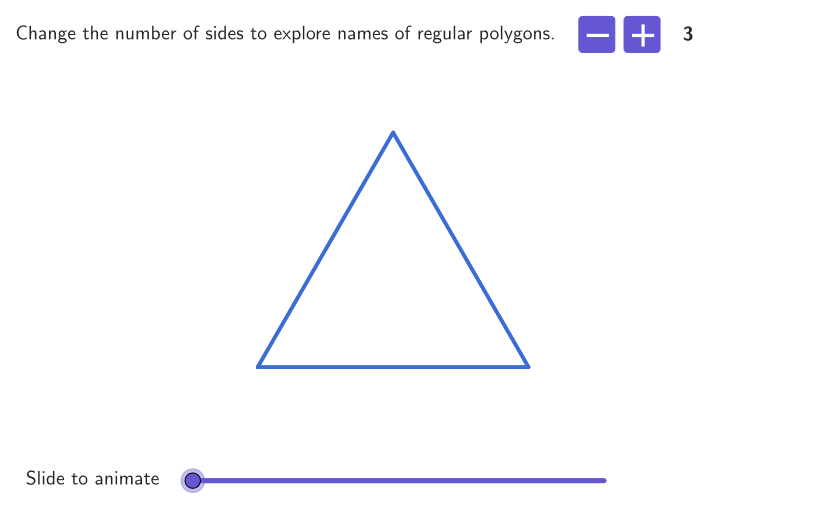
This interactive GeoGebra activity explores the connection between polygon names and their number of sides. Students discover how Greek number prefixes (tri-, quad-, pent-, hex-, oct-) determine polygon names. Key mathematical concepts include polygon definitions, naming conventions based on root words, and hierarchical classification of quadrilaterals. The construction uses Polygon command to create various regular polygons (triangle, square, hexagon, octagon), Dilate for scaling, Mirror for reflections, Shuffle and Element for random selection, If for conditional logic, and Sliders for dynamic interaction. Designed for grades 4-5 students learning basic geometry vocabulary.
GeoGebra Commands & Parameters
Polygon(J_2, K_2, 8) → oct, oct1, F_1, G_1, H_1, I_1, J_1, oct2, oct3, oct4, oct5, oct6, oct7, oct8, E_1Polygon(H_2, I_2, 6) → hex, hex1, U, hex2, hex3, hex4, hex5, hex6, Q, R, SPolygon(F_2, G_2, 4) → squa, squa1, squa2, squa3, squa4, G, HPolygon(D, E, 3) → tri, tri1, tri2, tri3, FPolygon(PT1, PT2, 5) → pent, pent1, pent2, pent3, pent4, pent5, L, M, NPolygon(O, P, 7) → hept, hept1, Z, A_1, B_1, hept2, hept3, hept4, hept5, hept6, hept7, V, WPolygon(C_1, D_1, 9) → nona, nona1, K_1, L_1, M_1, N_1, O_1, P_1, Q_1, nona2, nona3, nona4, nona5, nona6, nona7, nona8, nona9Polygon(DP1, DP2, 10) → deca, deca1, deca10, V_1, W_1, Z_1, A_2, B_2, C_2, D_2, E_2, deca2, deca3, deca4, deca5, deca6, deca7, deca8, deca9If(sides ≟ 3, 1.30, 1.2) → dilFDilate({tri1, tri2, tri3}, dilF, allCentr(3)) → allTriSidesDZip(Midpoint[t], t, allTriSidesD) → allTriMidDilate({squa1, squa2, squa3, squa4}, dilF, allCentr(4)) → allSquaSidesDZip(Midpoint[t], t, allSquaSidesD) → allSquaMidDilate({oct1, oct2, oct3, oct4, oct5, oct6, oct7, oct8}, dilF, allCentr(8)) → allOctSidesDZip(Midpoint[t], t, allOctSidesD) → allOctMidDilate({nona1, nona2, nona3, nona4, nona5, nona6, nona7, nona8, nona9}, dilF, allCentr(9)) → allNonaSidesDZip(Midpoint[t], t, allNonaSidesD) → allNonaMidDilate({hex1, hex2, hex3, hex4, hex5, hex6}, dilF, allCentr(6)) → allHexSidesDZip(Midpoint[t], t, allHexSidesD) → allHexMidDilate({hept1, hept2, hept3, hept4, hept5, hept6, hept7}, dilF, allCentr(7)) → allHeptSidesDZip(Midpoint[t], t, allHeptSidesD) → allHeptMidMirror(P1, yAxis) → P1'Mirror(P1', xAxis) → P1''Mirror(P1'', yAxis) → P1'''Polygon(P1, P1', P1'', P1''') → peep, p1, p1', p1'', p1'''SelectedIndex(ddMenu) → isShuffle(Sequence[t, t, -18, 18]) → val1List, {-9, -11, 18, 16, -3, -12, -1, 6, -5, -2, -16, 17, 5, -14, 1, 4, 14, -17, 10, -10, -7, -13, -8, 9, 13, 15, 11, -4, 0, -18, -15, 12, 2, -6, 3, 8, 7}Element(val1List, Mod[countQuestion, Length[val1List]] + 1) → val1Dilate({pent1, pent2, pent3, pent4, pent5}, dilF, allCentr(4)) → allPentSidesDZip(Midpoint[t], t, allPentSidesD) → allPentMidDilate({deca1, deca2, deca3, deca4, deca5, deca6, deca7, deca8, deca9, deca10}, dilF, allCentr(4)) → allDecaSidesDZip(Midpoint[t], t, allDecaSidesD) → allDecaMid
AI Drawing Prompt Reference
This prompt describes a geometric figure containing various regular polygons, such as triangles, squares, hexagons, and octagons. These polygons are related through scaling and reflection operations, illustrating the correspondence between Greek prefixes and polygon names. The figure also includes randomly selected elements to demonstrate dynamic interaction. The overall design aims to help students understand basic geometric concepts and naming conventions, suitable for grades 4-5.
The prompt above was compiled from the original drawing commands and is for reference only.