
Dynamic Triangle Angles and Geometric Construction
Loading the math board and drawing, please wait…
In collections
geometriadinamica.es
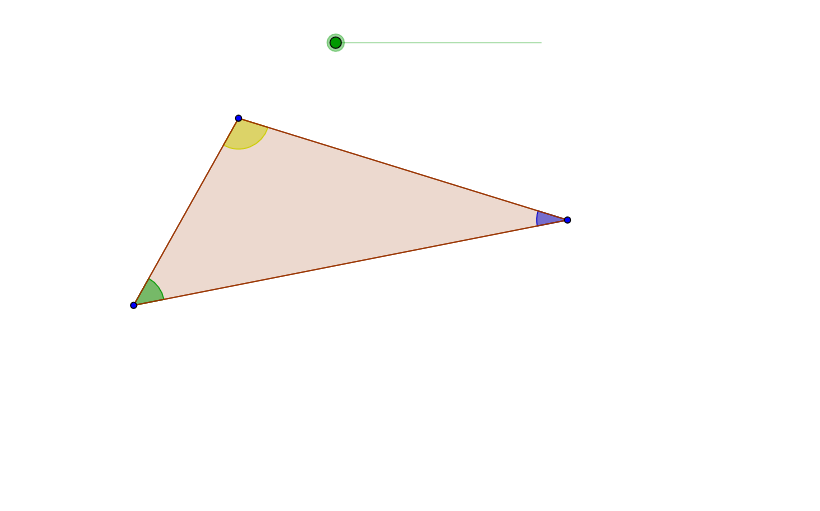
This GeoGebra example dynamically demonstrates the three interior angles of a triangle and their relationships, visually confirming that the sum of interior angles is 180°. Core mathematical concepts include triangle angles, angle measurement, polygon vertices and sides, and constructing auxiliary lines such as angle bisectors or perpendiculars to study angle variations. Construction highlights: uses Polygon to create triangle ABC, OrthogonalLine for perpendiculars, Intersect for intersection points, Midpoint for midpoints, Angle to mark each interior angle, and Segment to connect key points. Numerous auxiliary points (D, E, F, G, H, etc.) and lines (c, a, b, d, e, f, etc.) are employed for refined construction, allowing dynamic dragging of vertices to observe angle changes. Suitable for middle school geometry lessons on the triangle angle sum theorem, angle concepts, and geometric construction, as well as high school review of angle relationships and geometric proofs.
GeoGebra Commands & Parameters
Polygon(A, B, C) → P, c, a, bOrthogonalLine(A, a) → dIntersect(d, a) → DMidpoint(A, E) → FOrthogonalLine(F, d) → fIntersect(f, c) → GIntersect(f, b) → HPolygon(E, G, H) → Q, h, e_1, gMidpoint(I, B) → JOrthogonalLine(J, a) → iIntersect(i, c) → KPolygon(I, K, J) → R, j, i_1, kMidpoint(L, C) → MOrthogonalLine(M, a) → lIntersect(l, b) → NPolygon(N, L, M) → S, m, n, l_1Polygon(H, N, M, J, K, G) → T, h_1, n_1, m_1, j_1, k_1, g_1Angle(C, A, B) → αAngle(A, B, C) → βAngle(B, C, A) → γSegment(O, U) → pIntersect(f, p) → VAngle(G, E, V) → δIntersect(l, p) → WAngle(W, L, M) → εSegment(Y, Z) → qIntersect(i, q) → A_1Angle(A_1, I, J) → ζ
AI Drawing Prompt Reference
Draw a triangle ABC and mark the three interior angles at A, B, and C. Construct several auxiliary perpendicular lines: start from A with a perpendicular relative to a chosen direction line, find its intersections with the corresponding auxiliary lines, then use midpoints of segments to define additional perpendiculars and intersection points inside the figure. Connect the resulting key points with segments and form a couple of auxiliary polygons to study how the interior angles and related measured angles change as triangle vertices move. Include the required extra angle markings determined by three points defined through these constructions.
The prompt above was compiled from the original drawing commands and is for reference only.