
Sum of Interior Angles in Polygons
Loading the math board and drawing, please wait…
In collections
Interior and Exterior of Polygons
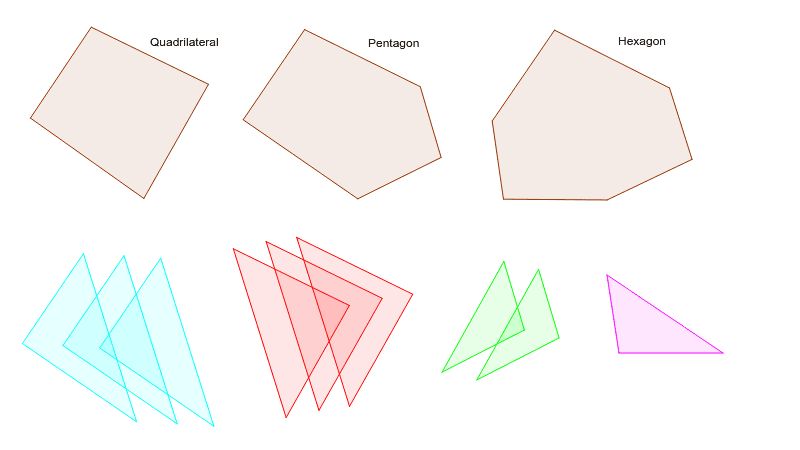
This example demonstrates how to fit triangles into polygons to understand the properties of the sum of interior angles. Key concepts include polygons, interior angles, and triangles. The Polygon command is used to construct polygons, and the changes in interior angles are observed by adjusting the vertices. Suitable for middle school and above students to learn geometric construction and the interior angle sum theorem.
GeoGebra Commands & Parameters
Polygon(A, B, C, D, E) → poly1, a, b, c, d, ePolygon(F, G, H) → poly2, h, f, gPolygon(I, J, K) → poly3, k, i, jPolygon(L, M, N) → poly4, n, l, mPolygon(O, P, Q, R, S, T) → poly5, o, p, q, r, s, tPolygon(Z, A_1, B_1, C_1) → poly7, z, a_1, b_1, c_1Polygon(F_1, G_1, H_1) → poly2_1, h_1, f_1, g_1Polygon(F_2, G_2, H_2) → poly2_2, h_2, f_2, g_2Polygon(I_1, J_1, K_1) → poly3_1, k_1, i_1, j_1Polygon(I_2, J_2, K_2) → poly3_2, k_2, i_2, j_2Polygon(L_1, M_1, N_1) → poly4_1, n_1, l_1, m_1Polygon(D_1, E_1, O_1) → poly8, o_1, d_1, e_1
AI Drawing Prompt Reference
Draw a pentagon, a triangle, a quadrilateral, and a hexagon, then divide each polygon into several triangles to observe and record the sum of the interior angles.
The prompt above was compiled from the original drawing commands and is for reference only.