
Subtracting Fractions Visualization
Loading the math board and drawing, please wait…
In collections
Jessica's Fraction Book
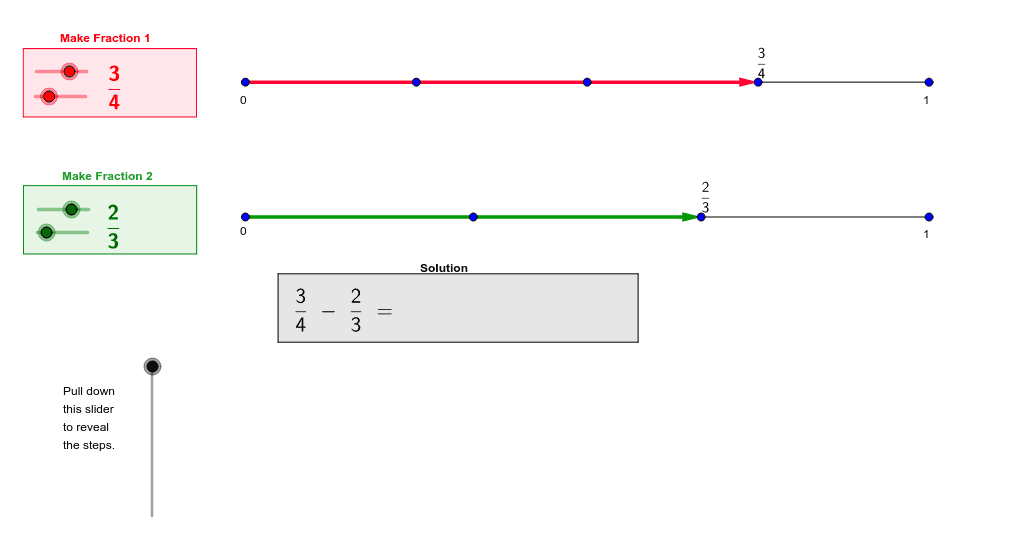
① This example visualizes the complete process of subtracting two fractions, showing how they are brought to a common denominator and then subtracted. ② Core mathematical concepts include fraction common denominator, least common multiple (LCM), greatest common divisor (GCD), and vector representation of fraction magnitude. ③ Construction highlights: GeoGebra commands Point, Segment, Sequence, LCM, GCD, Vector, Polygon are used to create numerator/denominator selectors, common denominator objects, arrows, and text labels (e.g., num1chooser, denom1, commondenom, frac1arrow, text2). ④ Suitable for upper‑primary to lower‑secondary mathematics instruction, teacher lesson preparation, and student self‑exploration.
GeoGebra Commands & Parameters
Point(a) → APoint(a) → BSegment(B, (x(B) + b, y(B))) → cSegment(A, (x(A) + b, y(A))) → dSequence((x(B) + b / denom1 * i, y(B)), i, 1, denom1) → frac1dotsSequence((x(A) + b / denom2 * i, y(A)), i, 1, denom2) → frac2dotsLCM(denom1, denom2) → commondenomSequence((x(B) + b / commondenom * i, y(B)), i, 1, commondenom) → frac1commondotsSequence((x(A) + b / commondenom * i, y(A)), i, 1, commondenom) → frac2commondotsVector(B, (x(B) + num1 * b / denom1, y(B))) → frac1arrowVector(A, (x(A) + num2 * b / denom2, y(A))) → frac2arrowGCD(rawdifference, commondenom) → reducebyPolygon(H, (x(H), y(H) - height), (x(H) + width, y(H) - height), (x(H) + width, y(H))) → poly1, h_1, j, k, lPolygon(I, (x(I), y(I) - height), (x(I) + width, y(I) - height), (x(I) + width, y(I))) → poly2, i_1, m, n, pPolygon(J, (x(J), y(J) - height), (x(J) + bigwidth, y(J) - height), (x(J) + bigwidth, y(J))) → poly3, j_1, q, r, s
AI Drawing Prompt Reference
Draw the process of subtracting two fractions. Start by creating points for the numerators and denominators of the two fractions, then use sequence commands to generate points for the numerators and denominators. Find the least common multiple of the denominators to generate points for the fractions with a common denominator. Use vectors to represent the sizes of the two fractions and calculate the absolute value of their difference. Finally, draw three rectangles to represent the two fractions and their difference.
The prompt above was compiled from the original drawing commands and is for reference only.