
Stellar Parallax Demonstration
Loading the math board and drawing, please wait…
In collections
MalinC's GeoGebra-book
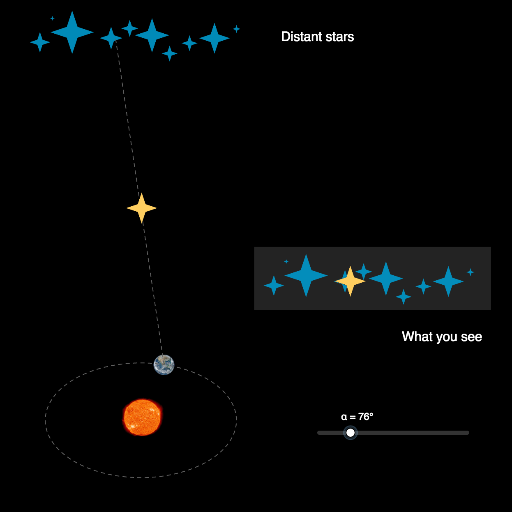
This example demonstrates the stellar parallax phenomenon, showing how the apparent position of a star changes as Earth orbits the Sun. It involves core mathematical concepts like trigonometry, vector operations, complex numbers, and coordinate geometry. The construction uses GeoGebra commands and objects such as Point, OrthogonalLine, Ray, Intersect, Vector, Translate, Segment, Polygon, Circle, and CurveCartesian to model celestial bodies and geometric shapes. Suitable for high school and above students learning about astronomical parallax measurements and geometric modeling applications.
GeoGebra Commands & Parameters
Point(yAxis) → Star0Point(yAxis) → AOrthogonalLine(A, yAxis) → aRay(Earth0, Star0) → bIntersect(b, a) → BVector(A, C) → uTranslate(B, u) → B'Vector(Star0, B') → vSegment(Earth0, B) → cOrthogonalLine(Rect1, yAxis) → dPoint(d) → Rect2OrthogonalLine(Rect2, d) → ePoint(e) → Rect3Polygon(Rect1, Rect2, Rect3, Rect4) → poly1, rect1, rect2, rect3, rect4Translate(pic1, u) → pic1'Circle((0, 0), 1) → SunCircleCurveCartesian(((earthOrbit * cos(t)) * 1.5), ((earthOrbit * sin(t)) * 0.9), t, 0, 6.283185307179586) → ellTranslate(pic2, v) → pic2'