
SSS Similarity Theorem Dynamic Exploration
Loading the math board and drawing, please wait…
In collections
Similarity & Right Triangle Trigonometry
Similarity, Right Triangles, and Trigonometry (SRT) Cluster
Similarity Theorems!
Similar Triangles Theorem
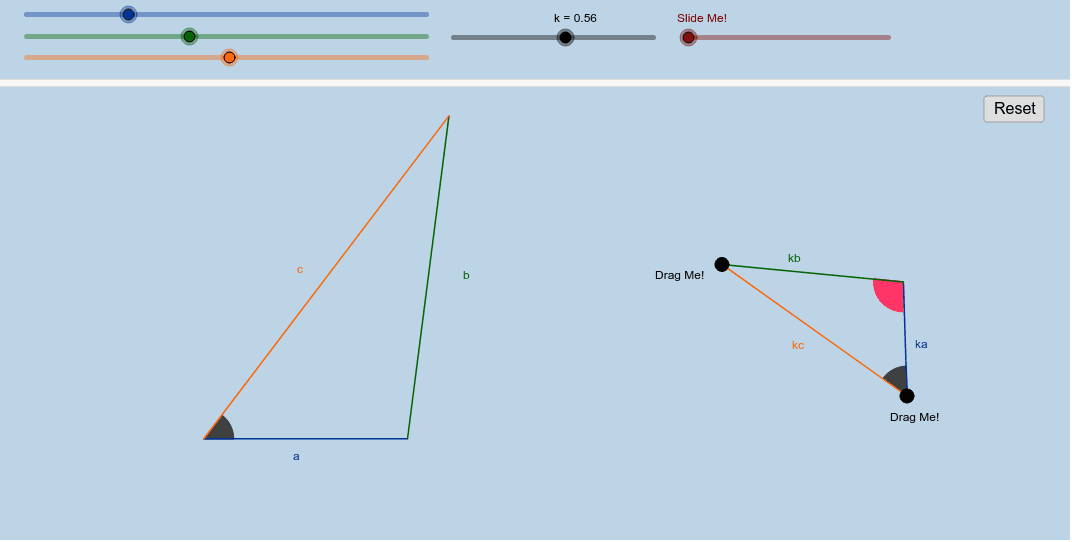
This GeoGebra applet enables students to dynamically explore the SSS (Side-Side-Side) Similarity Theorem for triangles. By manipulating side lengths and observing automatic similarity preservation, learners discover how proportional sides guarantee triangle similarity without rigorous proof. The construction leverages core GeoGebra commands including Circle, Intersect, Segment, Polygon, Dilate, Vector, and Rotate to maintain proportionality and angle consistency. It is ideal for middle and high school geometry classes, supporting visual reasoning and conceptual understanding of similarity transformations.
GeoGebra Commands & Parameters
Circle(A, a) → dIntersect(d, e) → B_1, BCircle(B, b) → fSegment(A, B) → gCircle(A, c) → k_1Intersect(k_1, f) → C, G, ,Segment(B, C) → hSegment(C, A) → iPolygon(A, B, C) → poly1, f_1, a_1, c_1Point(Circle[D, (k * i)]) → FSegment(D, F) → nCircle(D, (k * g)) → pCircle(F, (k * h)) → qIntersect(p, q, 2) → ESegment(D, E) → rSegment(F, E) → sCircle(A, 2) → tCircle(B, 2) → e_1Circle(D, 1.5) → d_1Circle(E, 1.5) → g_1Intersect(t, g, 1) → HIntersect(t, i, 1) → IIntersect(e_1, h, 1) → JIntersect(e_1, g, 1) → KIntersect(g_1, r, 1) → LIntersect(g_1, s, 1) → MIntersect(d_1, r, 1) → NIntersect(d_1, n, 1) → OCircleSector(D, N, O) → h_1CircleSector(E, M, L) → p_1Dilate(E, If[0 < o ≤ 1, 1 - o, 0], B) → D'Vector(E, D') → uDilate(D, If[1 < o ≤ 2, 2 - o, 0], A) → D'_1Vector(D, D'_1) → vLine(E, h) → b_1Intersect(g_1, b_1) → P, QAngle(M, E, Q) → αTranslate(p_1, u) → q_1CircleArc(E, M, L) → s_1Translate(h_1, v) → t_1Line(D, i) → i_1Intersect(d_1, i_1) → R, SAngle(O, D, R) → γCircleArc(D, N, O) → d_2Rotate(q_1, If[0 < o ≤ 1, (o * α), α], D') → e_2Rotate(t_1, If[1 < o ≤ 2, ((o - 1) * γ), γ], D'_1) → r_1
AI Drawing Prompt Reference
Draw two triangles, one original and one scaled proportionally to be similar. The original triangle has three sides with auxiliary circles at its vertices to define side lengths. The scaled triangle maintains proportional corresponding sides and equal corresponding angles. Draw vectors between corresponding vertices of the two triangles to indicate the scaling transformation. Additionally, draw circular arcs at the vertices of both triangles, using distinct colors or styles to show the correspondence of angles and sides in the similarity transformation. The overall figure is for dynamically exploring the side-side-side similarity theorem.
The prompt above was compiled from the original drawing commands and is for reference only.