
Square Roots of a Complex Number: Visualizing Two Roots in the Complex Plane
Loading the math board and drawing, please wait…
In collections
Roots of Complex Numbers
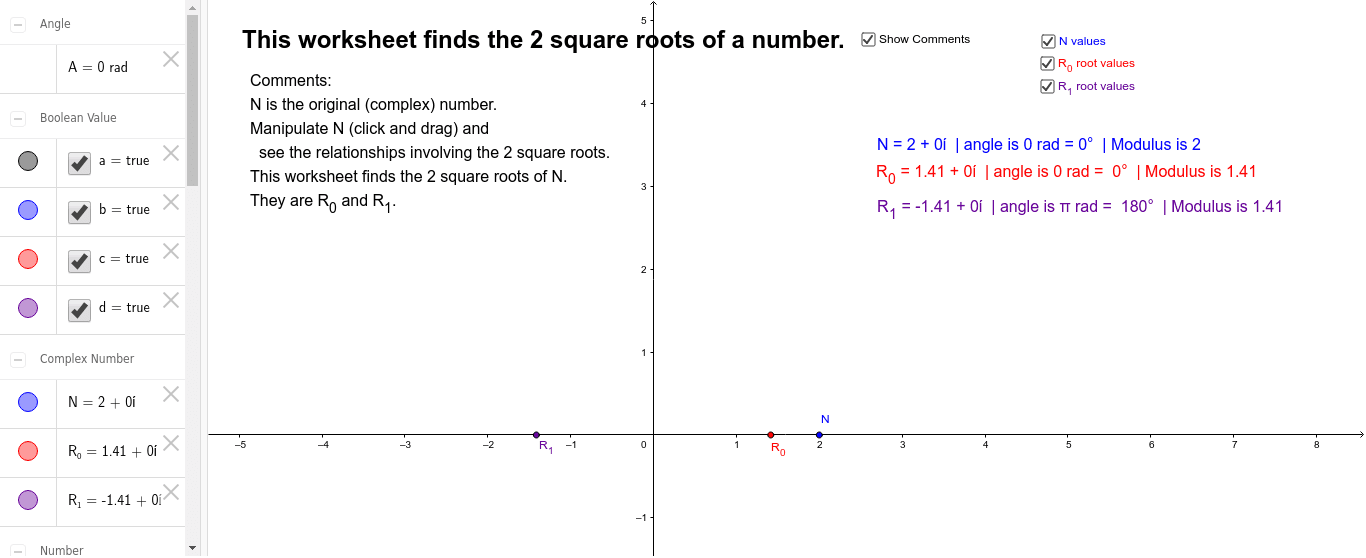
This GeoGebra worksheet visualizes the two square roots of a complex number N in the complex plane. It demonstrates the geometric interpretation of complex square roots using polar form and De Moivre's theorem: the modulus of each root is the square root of the original modulus, and the arguments are half the original argument (differing by π). The construction uses complex number objects (N, A, p) to define the input, computes the roots via polar conversion, marks the roots as points A₀ and A₁, and includes a slider k to adjust parameters. Text objects (text1–text5) explain the steps. This resource is ideal for high school or early college students learning complex numbers, and for teachers demonstrating the symmetry of roots in the complex plane.
GeoGebra Commands & Parameters
Point N(2.0, 0.0)arg(N)Numeric p(2.0)(A + 0) / p(A + (2 * π)) / pabs(N)^(1 / p)(r * ℯ^((ί * A_1)))(r * ℯ^((ί * A_0)))Boolean a(true)A / °Boolean b(true)A_0 / °A_1 / °abs(N)Boolean c(true)Boolean d(true)
AI Drawing Prompt Reference
Draw a complex plane with a point representing a complex number. Show its vector from the origin, along with its modulus and argument. Then compute the two square roots: take the square root of the modulus and halve the argument for the first root, and add π to the argument for the second root. Plot these two root points, using distinct colors or markers, and draw vectors from the origin to each root. Include a slider to adjust the original complex number's parameters, updating the display dynamically. Add text annotations explaining the polar form and De Moivre's theorem, emphasizing that the two roots are symmetric about the origin.
The prompt above was compiled from the original drawing commands and is for reference only.