
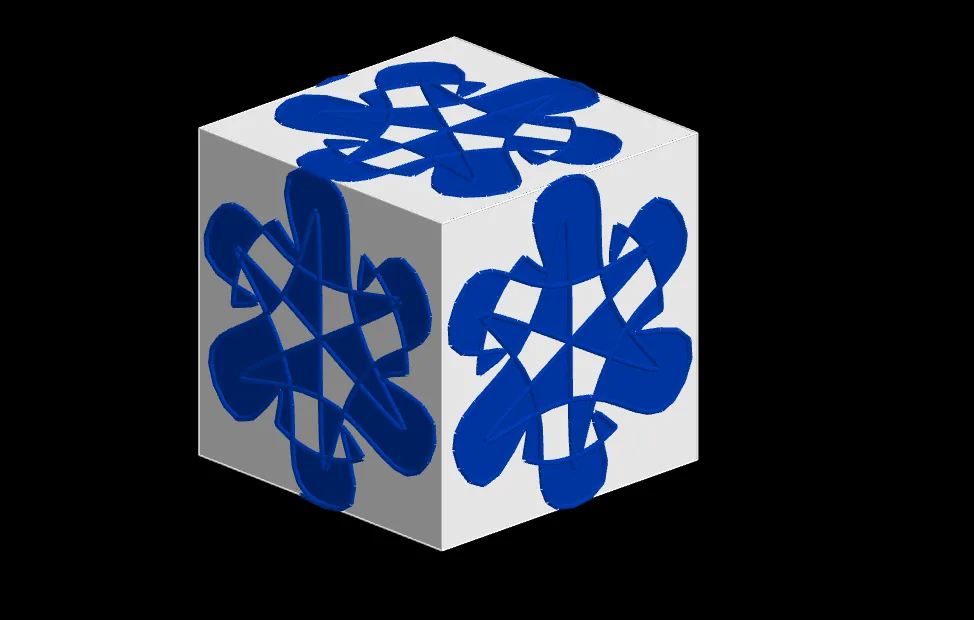
Spline's Cube Decorations
Loading the math board and drawing, please wait…
In collections
Color 3D surfaces
This example demonstrates the creation of intricate cube decorations using spline curves and geometric transformations. Key math concepts include solid geometry, transformation geometry, parametric equations, and function interpolation. GeoGebra commands like Join, Spline, Sequence, Polygon, Circle, Translate, and Sphere are used to construct the patterns. Suitable for high school and above students exploring applications of spatial geometry and parametric curves.
GeoGebra Commands & Parameters
Join({Sequence[(cos(i), sin(i)), i, 0, 6.283185307179586, (2 * π / m)], {(1 + d, 0), (1 + d, -1 - d), (-1 - d, -1 - d), (-1 - d, 1 + d), (1 + d, 1 + d), (1 + d, 0)}}) → liste6Spline(liste1, 3) → aSequence((cos(i), sin(i)), i, 0, (2 * π / n), (2 * π / ((n * m)))) → liste3Sequence(Point[a, i], i, 0, 1 - 1 / m, 1 / m) → liste2Sequence(Point[Rotate[a, (2 * π / n)], 1 - i], i, 1 / m, 1, 1 / m) → liste4Polygon(Join[{liste2, liste3, liste4}]) → poly1Polygon(liste6) → poly2Circle((0, 0), 1) → cSequence(Rotate[poly1, i], i, 0, 6.283185307179586, (4 * π / n)) → liste5Translate(poly2, Vector[(0, 0, 1 + d)]) → poly2'Translate(Rotate[poly2, 1.5707963267948966, xAxis], Vector[(0, d + 1, 0)]) → poly3Translate(liste5, Vector[(0, 0, 1 + d)]) → liste5'Sequence(Rotate[poly3, i, zAxis], i, 1.5707963267948966, 4.71238898038469, 1.5707963267948966) → liste7Translate(Rotate[liste5, 1.5707963267948966, xAxis], Vector[(0, d + 1, 0)]) → liste8Sequence(Rotate[liste8, i, zAxis], i, 1.5707963267948966, 4.71238898038469, 1.5707963267948966) → liste9Sphere((0, 0, 0), 0.9) → bTranslate(liste5, Vector[(0, 0, (-(1 + d)))]) → liste5'_1Polygon(G, H, F, I) → poly4, g, h, f, iPolygon(I, L, M, F) → poly5, i_1, l, m_1, f_1Polygon(G, J, L, I) → poly6, g_1, j, l_1, i_2Polygon(H, G, J, K) → poly7, h_1, g_2, j_1, kPolygon(F, H, K, M) → poly8, f_2, h_2, k_1, m_2Polygon(J, K, M, L) → poly9, j_2, k_2, m_3, l_2Polygon(R, W, V, U) → poly10, r, w, v, u