
Spiral Ramp 3D Modeling and Geometric Construction
Loading the math board and drawing, please wait…
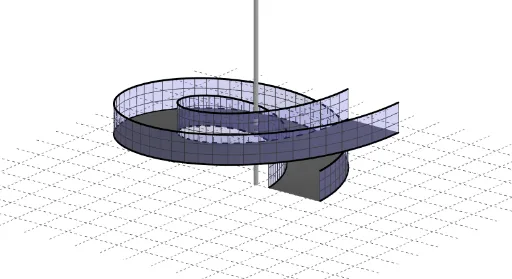
① This example demonstrates a spiral-shaped ascending ramp (Spiralförmiger Aufgang) in 3D, constructed using parametric curves and surfaces to create a helical staircase-like solid structure. ② Core mathematical concepts include spatial curves (CurveCartesian), parametric surfaces (Surface), rays (Ray), and the integration of geometric elements such as centroid, orthocenter, and tangents in three-dimensional space, along with circular/pie chart visualizations. ③ Construction highlights: GeoGebra commands Ray, Surface, and CurveCartesian are used to build the spiral path and surfaces; objects include parameters b, h, r, H for dimensions, Stange (rod), Boden (ground), Glas_1/Glas_2 (glass), and angle variables γ_1 to γ_4; Text1-3 provide annotations. ④ Suitable for high school to university levels in solid geometry, parametric equations, or 3D modeling instruction, and useful for mathematical experiments or artistic spiral structure design.
GeoGebra Commands & Parameters
Ray((0, 0, 0), (0, 0, 1)) → StangeSurface(((((a * r) * (t + 1)) + (s * b)) * cos(t)), ((((a * r) * (t + 1)) + (s * b)) * sin(t)), (h / ((2 * π)) * t), t, 0, (2 * π), s, 0, 1) → BodenSurface((((a * r) * (t + 1)) * cos(t)), (((a * r) * (t + 1)) * sin(t)), (h / ((2 * π)) * t) + (s * H), t, 0, (2 * π), s, 0, 1) → Glas_1Surface(((((a * r) * (t + 1)) + b) * cos(t)), ((((a * r) * (t + 1)) + b) * sin(t)), (h / ((2 * π)) * t) + (s * H), t, 0, (2 * π), s, 0, 1) → Glas_2CurveCartesian((((a * r) * (t + 1)) * cos(t)), (((a * r) * (t + 1)) * sin(t)), (h / ((2 * π)) * t), t, 0, (2 * π)) → γ_1CurveCartesian(((((a * r) * (t + 1)) + b) * cos(t)), ((((a * r) * (t + 1)) + b) * sin(t)), (h / ((2 * π)) * t), t, 0, (2 * π)) → γ_2CurveCartesian((((a * r) * (t + 1)) * cos(t)), (((a * r) * (t + 1)) * sin(t)), H + (h / ((2 * π)) * t), t, 0, (2 * π)) → γ_3CurveCartesian(((((a * r) * (t + 1)) + b) * cos(t)), ((((a * r) * (t + 1)) + b) * sin(t)), 1 + (h / ((2 * π)) * t), t, 0, (2 * π)) → γ_4