
Spiral Galaxy Arms: Parametric Curves and Calculus Visualization
Loading the math board and drawing, please wait…
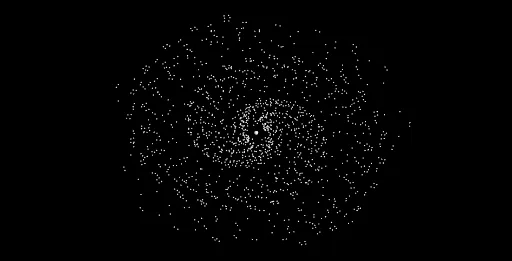
This GeoGebra example dynamically visualizes the mathematical structure of spiral galaxy arms, using parametric equations to generate spiral-like curves that mimic stellar distribution and arm patterns. The core mathematical concepts include parametric curves, polar coordinates, slope and difference in calculus, and sequence generation. Construction highlights: the Sequence command creates a series of points or parameter values, Take extracts subsets, and CurveCartesian defines Cartesian parametric curves. Key objects include n (number of terms), a (coefficient), c (constant), O (origin), R (radius), Fact (factor), lists liste1 through liste10, curves l1 through l10, Speed (slider controlling animation), and image1 (background image). Suitable for high school to undergraduate students learning parametric equations, introductory calculus, or mathematical modeling, as well as for astronomy outreach demonstrating the link between mathematics and natural phenomena. By adjusting sliders, users can observe how the winding tightness and density of arms change, gaining intuitive insight into how difference and slope influence curve shape.
GeoGebra Commands & Parameters
Sequence(Rotate[O + (((1 / n * i) * R), 0), a + (Fact * i), O], i, 0, c) → liste1Sequence(Rotate[O + ((((-(1 / n)) * i) * R), 0), a + (Fact * i), O], i, 0, c) → liste2Sequence(Rotate[O + (((1 / n * i) * d), 0), a + (Fact * i) + π / 2, O], i, 0, c) → liste3Sequence(Ellipse[Element[liste1, i], Element[liste2, i], Element[liste3, i]], i, 1, Length[liste1]) → liste4Sequence(Line[Element[liste1, i], Element[liste2, i]], i, 1, Length[liste1]) → l1Sequence((x(O) + (R * cos(i)), y(O) + (d * sin(i))), i, 0, 50, 10) → liste5Sequence(Sequence[Rotate[Element[liste5, j] + (((1 / n * i) * R), 0), (-a) + (Fact * i), O], i, 0, 60], j, 1, Length[liste5]) → l4Sequence((x(O) + ((d - 0.5) * cos(i)), y(O) + ((R + 0.5) * sin(i))), i, 0, 50, 10) → l5Sequence(Sequence[Rotate[Element[l5, j] + (((1 / n * i) * R), 0), (-a) + (Fact * i), O], i, 0, 60], j, 1, Length[l5]) → l6Sequence(Sequence[Rotate[Element[l5, j] + (((1 / n * i) * R), 0), (-a) + (3.62 * i), O], i, 0, 60], j, 1, Length[l5]) → l7Sequence(Sequence[Rotate[Element[l5, j] + (((1 / n * i) * R), 0), (-a) + (3 * i), O], i, 0, 60], j, 1, Length[l5]) → l8Take(liste4, 1, If[c < 50, c, 50]) → l2Take(l1, If[c < 50, c, 50], If[c < 50, c, 50]) → l3CurveCartesian(x(O) + (i * cos(i - a)), y(O) + (i * sin(i - a)), z(O), i, 0, (4 * π)) → bSequence((x(O) + (i * cos(i - a)), y(O) + (i * sin(i - a)), z(O)), i, 0, (4 * π), 0.05) → l9Sequence((x(O) + ((i + 0.1) * cos(i - a)), y(O) + ((i + 0.1) * sin(i - a)), z(O)), i, 0, (4 * π), 0.1) → l10
AI Drawing Prompt Reference
Draw a mathematical visualization of spiral galaxy arms. Start with a central origin, generate two symmetric sets of rotating points, one expanding outward and one contracting inward, to form the arm skeletons. Connect corresponding points with ellipses and lines to show arm thickness. Add multiple families of curves from rotated point sequences, plus a logarithmic spiral as the main arm. Use sliders to control winding tightness, extension length, and rotation angle. The overall shape should resemble a spiral galaxy, illustrating how parametric curves and calculus concepts like slope and difference affect the form.
The prompt above was compiled from the original drawing commands and is for reference only.