
Sphere on Sphere
Loading the math board and drawing, please wait…
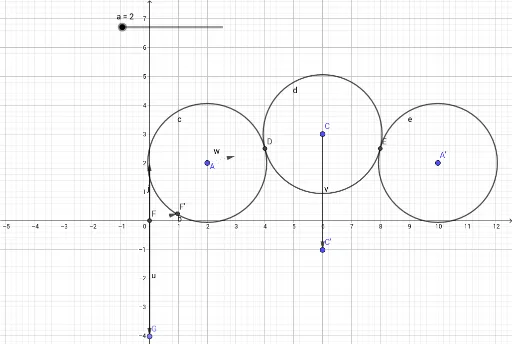
This example demonstrates the geometric relationship between spheres. Key mathematical concepts include the intersection and projection of spheres in solid geometry. Using GeoGebra commands such as Mirror, Segment, Angle, Midpoint, Circle, Intersect, Point, Vector, Translate, the dynamic model of a sphere on a sphere is constructed. Suitable for high school or university-level solid geometry studies.
GeoGebra Commands & Parameters
Mirror(A, B) → A'Segment(A, B) → fSegment(B, C) → gSegment(A, C) → hAngle(B, A, C) → αMidpoint(A, C) → DCircle(A, D) → cCircle(C, D) → dSegment(C, A') → iMidpoint(C, A') → ECircle(A', E) → eIntersect(xAxis, yAxis) → FPoint(yAxis) → GVector(F, G) → uTranslate(C, u) → C'Vector(C, C') → vUnitVector(h) → wTranslate(F, w) → F'Vector(F, F') → b
AI Drawing Prompt Reference
Draw two intersecting spheres, with the center of one sphere on the surface of the other. Start by drawing the centers A and C of the two spheres and the line segment AC connecting them. Find the midpoint D of AC and draw a circle c with A and D, and a circle d with C and D. Mirror A to get A', and draw the line segment CA' with C and A'. Find the midpoint E of CA' and draw a circle e with A' and E. Find the intersection point F of the x-axis and y-axis, draw vector u from F to a point G on the y-axis, translate C along u to get C', find the vector v from C to C', find the unit vector w from h, translate F along w to get F', and find vector b from F to F'.
The prompt above was compiled from the original drawing commands and is for reference only.