
Spaceship Racing Game by cemccourseware
Loading the math board and drawing, please wait…
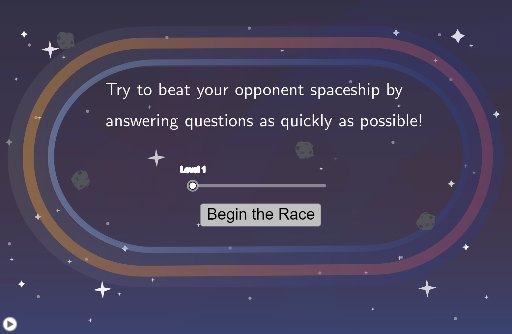
This example simulates a spaceship racing game to demonstrate basic mathematical concepts such as addition, integers, and subtraction. Using GeoGebra commands like Intersect, Point, and Segment, the process of mathematical operations is dynamically illustrated. Suitable for students from upper elementary to middle school, it helps them understand the practical application of mathematical concepts.
GeoGebra Commands & Parameters
Intersect(xAxis, yAxis) → APoint(xAxis) → BSegment(A, B) → fPoint(yAxis) → CSegment(C, D) → gSemicircle(D, B) → cSemicircle(A, C) → dLaTeX(Text[RandNum1]) → DisplayRandNum1LaTeX(Text[RandNum2]) → DisplayRandNum2LaTeX(Text[RandAns]) → DisplayRandAnsRandomElement(ListOfSymbols) → DiceRollText("test") → DisplaySymbolLaTeX(Text[RandAnsFake1]) → DisplayRandAnsFake1LaTeX(Text[RandAnsFake2]) → DisplayRandAnsFake2RandomElement({1, 2, 3}) → FakeRoll1RandomElement({1, 2, 3}) → FakeRoll2Circle((0.5, 1.5), 0.6) → CircOutline1Circle((2, 1.5), 0.6) → CircOutline2Circle((3.5, 1.5), 0.6) → CircOutline3Shuffle(ListOfPoints) → ListOfPointsShuffledCircle(Point1, 0.6) → TouchArea1Circle(Point2, 0.6) → TouchArea2Circle(Point3, 0.6) → TouchArea3LaTeX(Text["Incorrect\ Answers: " + Incorrect]) → DisplayIncorrectSequence(Element[TimesList, 1 + i] - Element[TimesList, i], i, 1, Length[TimesList] - 1) → OldAverageSpeedListLaTeX(Text["Your\ Score: " + Score]) → DisplayScoreSegment((0, -0.25), (0, 0.45)) → startsegmentSegment((-2.35, 2), (-1.55, 2)) → endsegmentText("Finish") → EndTextLaTeX(Text["Try\ to\ beat\ your\ opponent\ spaceship\ by\\\ \\answering\ questions\ as\ quickly\ as\ possible!"]) → feedback