
Solving Linear Inequalities (Advanced)
Loading the math board and drawing, please wait…
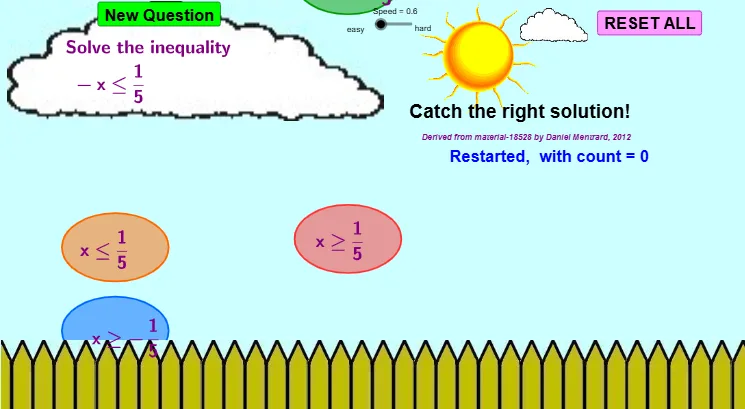
This is an advanced exercise for solving linear inequalities with linear expressions on both sides. Presented as a game, it helps students master the skills of solving linear inequalities. It uses commands like RandomElement, Random, If, Simplify, and others in GeoGebra, suitable for high school students or math enthusiasts.
GeoGebra Commands & Parameters
RandomElement(listcoeffA1C1) → linel3coeffxRandomElement({1, 2, 1, 3, 1, 5, 1}) → ansvaldenomRandom(-5, 7) → ansvalnumRandomElement({-3, -2, -1, 2, 3, 4, 5}) → factoraIf(abs((answervalue * factora)) - floor(abs((answervalue * factora))) ≟ 0, RandomElement[listcoeffB1] - (answervalue * factora), RandomElement[listcoeffB1]) → linel3constIf(Length[Coefficients[A12]] ≟ 1, {0, Element[Coefficients[A12], 1]}, Coefficients[A12]) → listcoeffA10If(Element[listcoeffA10, 1] ≟ 0 ∨ Element[listcoeffA10, 2] ≟ 0, 1, GCD[{Element[listcoeffA10, 1], Element[listcoeffA10, 2]}]) → A10coeffHCFSimplify(x - x + ((answervalue * factora) * ansvaldenom)) → C16Coefficients(C12) → listcoeffC10RandomElement(Join[{Remove[{-1, 1}, {If[Element[listcoeffC10, 1] < 0 ∧ Element[listcoeffC10, 2] < 0 ∨ Element[listcoeffC10, 1] < 0, -1, 1]}], {If[Element[listcoeffC10, 1] < 0 ∧ Element[listcoeffC10, 2] < 0 ∨ Element[listcoeffC10, 1] < 0, -1, 1]}}]) → C9coeffouterIf(Element[listcoeffC10, 1] ≟ 0 ∨ Element[listcoeffC10, 2] ≟ 0, 1, (GCD[Element[listcoeffC10, 1], Element[listcoeffC10, 2]] * C9coeffouter)) → C10coeffHCFRandom(1, 4) → SelectedIneqListIndexNumRandom(1, 4) → rrRandom(1, 10) → bbRandom(1, 10) → ccIf(texte1 ≟ "" + dd, 1, 0) → vraiIf(t > -4.9, Random[1, 4] + 0, Random[1, 4]) → iIf(rr ≟ 1, A, If[rr ≟ 2, B, If[rr ≟ 3, C, D]]) → MIf(rr ≟ 1, B, If[rr ≟ 2, C, If[rr ≟ 3, D, A]]) → NIf(rr ≟ 1, C, If[rr ≟ 2, D, If[rr ≟ 3, A, B]]) → PIf(rr ≟ 1, D, If[rr ≟ 2, A, If[rr ≟ 3, B, C]]) → QIf(factora < 0, If[SelectedIneqListIndexNum < 2, 2, If[SelectedIneqListIndexNum > 3, 3, If[SelectedIneqListIndexNum < 3, 1, 4]]], SelectedIneqListIndexNum) → DisplayIneqListIndexNumIf(SelectedIneqListIndexNum > 2, If[SelectedIneqListIndexNum > 3, 3, 4], If[SelectedIneqListIndexNum < 2, 2, 1]) → distractor1symbolIndexSimplify(g(x) / factora) → g_0RandomElement({1, 1, -1, 1, 2, 1, 2, 1, 3, 1, 3, 1, 4, 1, 5, 1, -2}) → K1RandomElement({1, RandomElement[{2, 3, -2, -3}]}) → M1RandomElement(listcoeffB1) → B1Random(-15, 15) → D1RandomElement({0, 1, 2, 3, RandomElement[Remove[listcoeffA1C1, {Element[listcoeffB1, IndexOf[B1, listcoeffB1]]}]]}) → A1RandomElement(Remove[listcoeffA1C1, {A1, Element[listcoeffB1, IndexOf[B1, listcoeffB1]]}]) → C1Coefficients(A4) → line2leftcoeffCoefficients(C4) → line2rightcoeffSimplify(A4) → A5Simplify(C4) → C5Simplify(A6) → A7If(C5(3) ≟ C5(0), C5(0) - A5(0), C5(0) - A5(0) - C5(0) - A5(0)) → C5(0)Simplify(C6) → C7Text(Element[ListIneqSymGenerated, SelectedIneqListIndexNum]) → B20FractionText(factora) → D20Simplify(x - x + answervalue) → C20RandomElement(listcoeffB1) → linel2const2If(factora < 0, Element[ListIneqSymGeneratedNegative, SelectedIneqListIndexNum], Element[ListIneqSymGenerated, SelectedIneqListIndexNum]) → B16FractionText(answervalue) → E20Ellipse(A - (circleradius, 0), A + (circleradius, 0), A + ((circleradius * ellipseaxisfactor), 0)) → cEllipse(B - (circleradius, 0), B + (circleradius, 0), B + ((circleradius * ellipseaxisfactor), 0)) → kEllipse(D - (circleradius, 0), D + (circleradius, 0), D + ((circleradius * ellipseaxisfactor), 0)) → qEllipse(C - (circleradius, 0), C + (circleradius, 0), C + ((circleradius * ellipseaxisfactor), 0)) → r
AI Drawing Prompt Reference
Create a coordinate geometry illustration showing the solution of linear inequalities. Include two lines and inequality symbols, controlled by sliders, with randomly generated values and expressions to demonstrate the solving process. Draw two lines first, then fill the region according to the inequality symbols, and finally use ellipses and text to annotate key points and parameter values.
The prompt above was compiled from the original drawing commands and is for reference only.