
Solar System Simulation
Loading the math board and drawing, please wait…
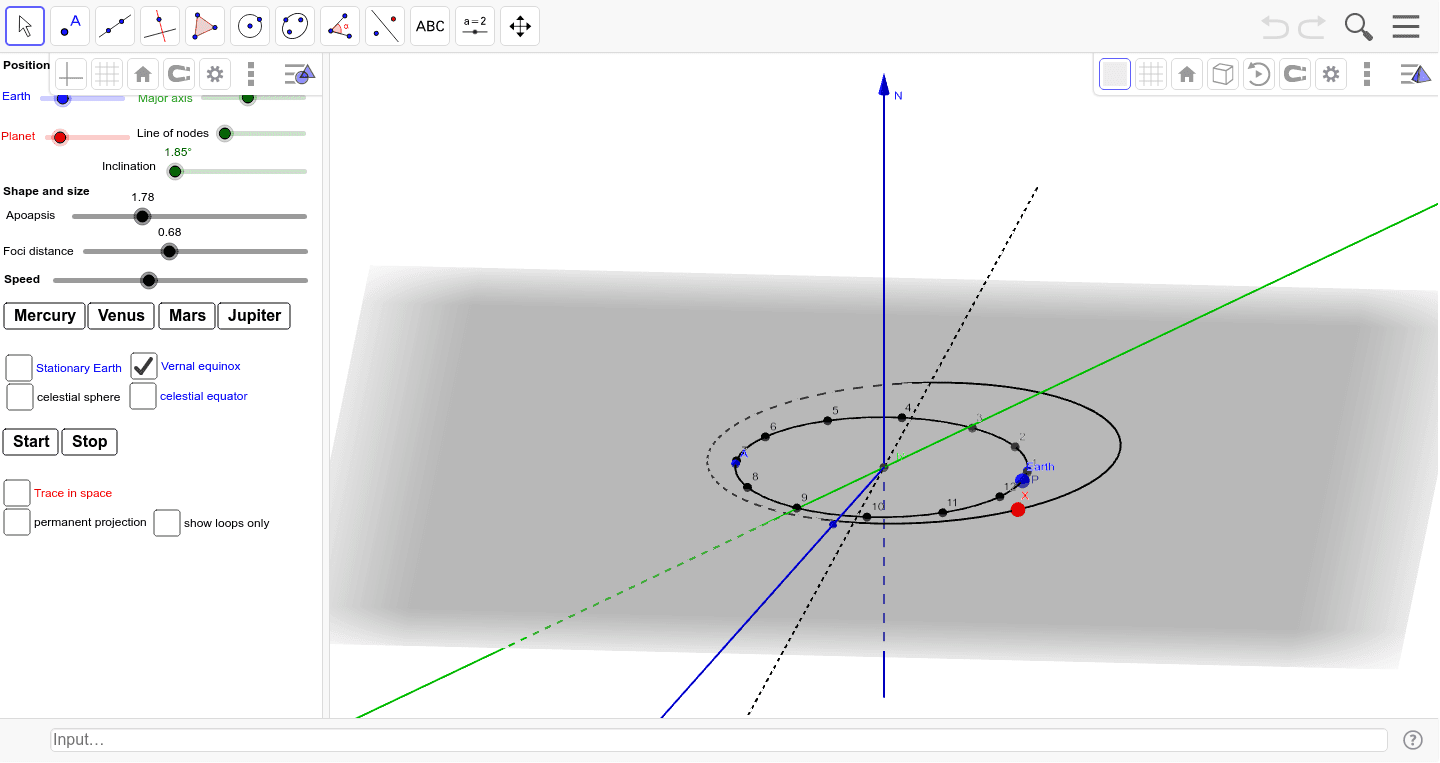
This example demonstrates the 3D graphic of Earth and an arbitrary Planet X orbiting the Sun in the ecliptic plane. It involves core mathematical concepts such as ellipse, plane figures, vectors, rotation, and locus. The construction utilizes GeoGebra commands and objects like Ellipse, Rotate, Angle, Ray, Intersect, Circle, Line, Point, Vector, Translate, Segment, Sphere, Tangent, Plane, OrthogonalLine, and IntersectPath. Suitable for high school and above students to learn about celestial motion and geometric relationships.
GeoGebra Commands & Parameters
Ellipse(A, B, C) → cRotate(C, α, A) → C'Angle(C, A, C') → βRay(A, C') → aIntersect(c, a) → D,Circle(A, Segment[A, E]) → dRotate(E, γ, A) → E'Angle(E, A, E') → δLine(A, E') → bPoint(b) → GRotate(G, ε, E') → G'Angle(G, E', G') → ζRay(E', G') → gRotate(C, 257.1*°, A) → C'_1Angle(C, A, C'_1) → ηLine(A, C'_1) → hRotate(C, 83.4*°, A) → C'_2Vector(D, A) → uTranslate(D, u) → D'Point(Circle[A, k]) → JSegment(A, J) → lRotate(J, γ, A) → J'Angle(J, A, J') → ιPoint(Circle[A, m]) → KSegment(A, K) → nRotate(K, γ, A) → K'Angle(K, A, K') → κEllipse(A, K', J') → pRotate(C, θ, A) → C'_3Angle(C, A, C'_3) → ξLine(A, C'_3) → iRotate(A, ε, K') → A'Angle(A, K', A') → μRay(K', A') → qRotate(p, Tilt, i) → p'Rotate(K', Tilt, i) → K''Rotate(A', Tilt, i) → A''Ray(K'', A'') → q'Intersect(q', p') → M, NSegment(D, M) → rVector(D, A) → vTranslate(D, v) → D'_1Translate(M, v) → M'Segment(D'_1, M') → r'Sphere(D'_1, k) → oRay(D'_1, M') → sIntersect(s, o) → O, PTangent(D, p') → t, a_1Intersect(t, p') → Q, RIntersect(a_1, p') → S, TIntersect(c, xAxis, 1) → UIntersect(c, xAxis, 2) → VPoint(c) → WPoint(c) → ZPoint(c) → Z_1Point(c) → C_1Point(c) → E_1Intersect(c, h, 2) → A_1Point(c) → B_1Point(c) → D_1Point(c) → F_1Point(c) → G_1Point(c) → H_1Point(c) → I_1Point(c) → J_1Point(c) → K_1Plane(F_1, B_1, J_1) → wRotate(w, 23.4*°, h) → w'OrthogonalLine(D'_1, w') → b_1IntersectPath(w', o) → c_1Intersect(q, q') → HIntersect(q, q') → IIntersect(q, q') → FIntersect(q, q') → LIntersectIntersect(p, p') → L_1, O_1, ,Intersect(p, q) → M_1, N_1Rotate(b, Tilt, i) → b'Intersect(zAxis, b') → R_1Point(h) → U_1Ray(R_1, U_1) → h_1Point(h_1) → V_1Vector(U_1, V_1) → u_1Intersect(h_1, c, 1) → W_1
AI Drawing Prompt Reference
Create a 3D simulation of a solar system, including the Sun, Earth, and an arbitrary planet X orbiting the Sun. Start by drawing the elliptical orbits of Earth and the arbitrary planet X around the Sun. Then rotate Earth and the planet X, calculate the angles, and draw their trajectories. Next, add other celestial bodies like Earth's satellite, and finally combine all the bodies and their orbits to form a complete solar system model.
The prompt above was compiled from the original drawing commands and is for reference only.