
Museo de Onda: Azulejo 4
Loading the math board and drawing, please wait…
In collections
geometriadinamica.es
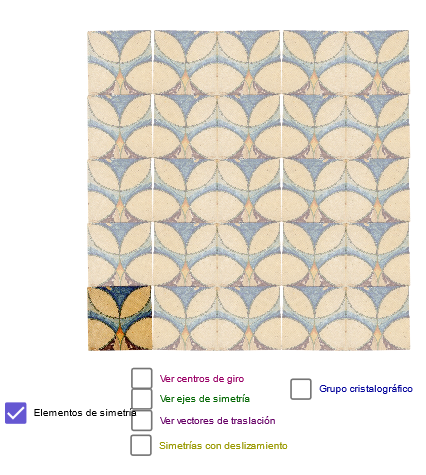
This example demonstrates the geometric construction and transformation of a tile pattern in three-dimensional space. It involves core mathematical concepts such as vectors, 3D geometry, function graphs, and geometric transformations. GeoGebra commands like Line, Point, OrthogonalLine, Intersect, Midpoint, Mirror, Rotate, Vector, and Translate are used in the construction process. It is suitable for high school and above students learning about solid geometry, vector operations, and geometric constructions.
GeoGebra Commands & Parameters
Line(A, B) → bLine(G, b) → ePoint(e) → JOrthogonalLine(J, e) → hOrthogonalLine(G, e) → fPoint(f) → HOrthogonalLine(H, f) → gIntersect(g, h) → EMidpoint(E, H) → IMidpoint(I, E) → B_1Midpoint(G, J) → DMidpoint(J, E) → FMidpoint(H, G) → KMidpoint(D, I) → LMidpoint(K, L) → MMidpoint(L, F) → NMidpoint(F, J) → OMidpoint(J, D) → PMidpoint(G, D) → QMidpoint(K, G) → RMidpoint(Q, M) → SMidpoint(L, D) → TMidpoint(P, N) → UMidpoint(F, E) → VMidpoint(K, H) → WMidpoint(W, V) → ZMidpoint(H, I) → A_1Midpoint(N, B_1) → C_1Midpoint(Z, W) → D_1Midpoint(D, U) → E_1Midpoint(U, J) → F_1Midpoint(T, Q) → G_1Midpoint(S, G) → H_1Midpoint(S, K) → I_1Midpoint(M, T) → J_1Midpoint(T, N) → K_1Midpoint(N, O) → L_1Midpoint(F, C_1) → M_1Midpoint(C_1, L) → N_1Midpoint(L, D_1) → O_1Midpoint(D_1, K) → P_1Midpoint(H, D_1) → Q_1Midpoint(D_1, I) → R_1Midpoint(I, C_1) → S_1Midpoint(C_1, E) → T_1Mirror(F_1, h) → U_1Mirror(L_1, h) → V_1Mirror(M_1, h) → W_1Mirror(T_1, h) → Z_1Mirror(B_1, h) → A_2Mirror(L_1, h) → C_2Line(S, A_1) → tLine(I, T) → a_1Line(U, B_1) → b_1Line(E_1, N_1) → c_1Line(F_1, M_1) → d_1Line(G_1, R_1) → e_1Line(W_1, P_1) → g_1Line(Q_1, Z_1) → h_1Point(a_1) → F_2Point(b) → A1Min(90, ((a - 1) * 90)) → r1Rotate(F_2, ((-r1))°, T) → K_{11}Rotate(T, ((-r1))°, T) → T'_7Rotate(U, ((-r1))°, T) → U'_3Rotate(T, ((-r1))°, T) → T'_8Rotate(T, ((-r1))°, T'_8) → T'_9Rotate(F_2, ((-r1))°, T) → J_{13}Rotate(L, ((-r1))°, T) → L'_2Mirror(U'_3, b_1) → A_{14}Mirror(T'_8, b_1) → B_{14}Mirror(T'_9, b_1) → O_{15}Mirror(K_{11}, b_1) → G_{16}Mirror(T'_7, b_1) → H_{16}Mirror(J_{13}, b_1) → J_{17}Mirror(L'_2, b_1) → K_{17}Midpoint(C_1, E) → K_{20}Line(G_1, O_1) → l_1Point(a_1) → CMin(180, ((a - 1) * 180)) → r2Min(270, ((a - 1) * 270)) → r3Rotate(T, r1°, T) → T'_4Rotate(F_2, r1°, T) → G_2Rotate(T, r2°, T) → T'_5Rotate(F_2, r2°, T) → J_2Rotate(T, r3°, T) → T'_6Rotate(F_2, r3°, T) → N_2Rotate(F_2, r1°, T) → Q_2Rotate(C, r1°, T) → C'Rotate(F_2, r2°, T) → Z_2Rotate(C, r2°, T) → C'_1Rotate(F_2, r3°, T) → H_3Rotate(C, r3°, T) → C'_2Rotate(C, r1°, T) → C'_3Rotate(L, r1°, T) → L'_1Rotate(K_1, r1°, T) → Q_3Rotate(C, r2°, T) → C'_4Rotate(L, r2°, T) → L'_3Rotate(K_1, r2°, T) → Z_3Rotate(C, r3°, T) → C'_5Rotate(L, r3°, T) → L'_4Rotate(K_1, r3°, T) → H_4Mirror(C'_4, a_1) → F_5Mirror(L'_3, a_1) → G_5Mirror(Z_3, a_1) → J_5Mirror(Z_2, a_1) → O_5Mirror(C'_1, a_1) → P_5Mirror(T'_5, a_1) → W_5Mirror(J_2, a_1) → Z_5Mirror(C, a_1) → C'_6Mirror(L, a_1) → L'_5Mirror(K_1, a_1) → R_6Mirror(F_2, a_1) → T_6Mirror(C, a_1) → C'_7Mirror(T, a_1) → T'_{10}Mirror(F_2, a_1) → W_6Min(180, ((a - 5.5) * 180)) → r4Line(S, O) → qLine(F, M) → rLine(D_1, V) → sMirror(pic1, t) → pic1'Mirror(pic1', a_1) → pic1''Mirror(pic1'', b_1) → pic1'''Mirror(pic1''', h) → pic2Vector(C_1, V) → u_1Line(E_1, l_1) → f_1Line(F_1, f_1) → k_1Vector(V, F) → uTranslate(pic1, u) → pic1'_1Translate(pic1', u) → pic1''_1Translate(pic1'', u) → pic1'''_1Translate(pic1''', u) → pic3Translate(pic2, u) → pic2'Translate(pic2', u) → pic2''Translate(pic3, u) → pic3'Translate(pic2'', u) → pic2'''Translate(pic2''', u) → pic4Translate(pic3', u) → pic3''Translate(pic3'', u) → pic3'''Translate(pic1'''_1, u) → pic5Translate(pic5, u) → pic5'Translate(pic5', u) → pic5''Translate(pic1''_1, u) → pic6Translate(pic6, u) → pic6'Translate(pic6', u) → pic6''Translate(pic1'_1, u) → pic7Translate(pic7, u) → pic7'Translate(h, u) → h'Translate(pic7', u) → pic7''Vector(C_1, N) → w
AI Drawing Prompt Reference
Draw a tile pattern in three-dimensional space, consisting of multiple points and line segments. Use methods of intersection, midpoint, and mirroring to construct a complex geometric shape. Start by defining two lines b and e, then gradually build a series of points and line segments through these operations, ultimately forming a symmetrical 3D pattern.
The prompt above was compiled from the original drawing commands and is for reference only.