
Inner Planet Phases Simulation
Loading the math board and drawing, please wait…
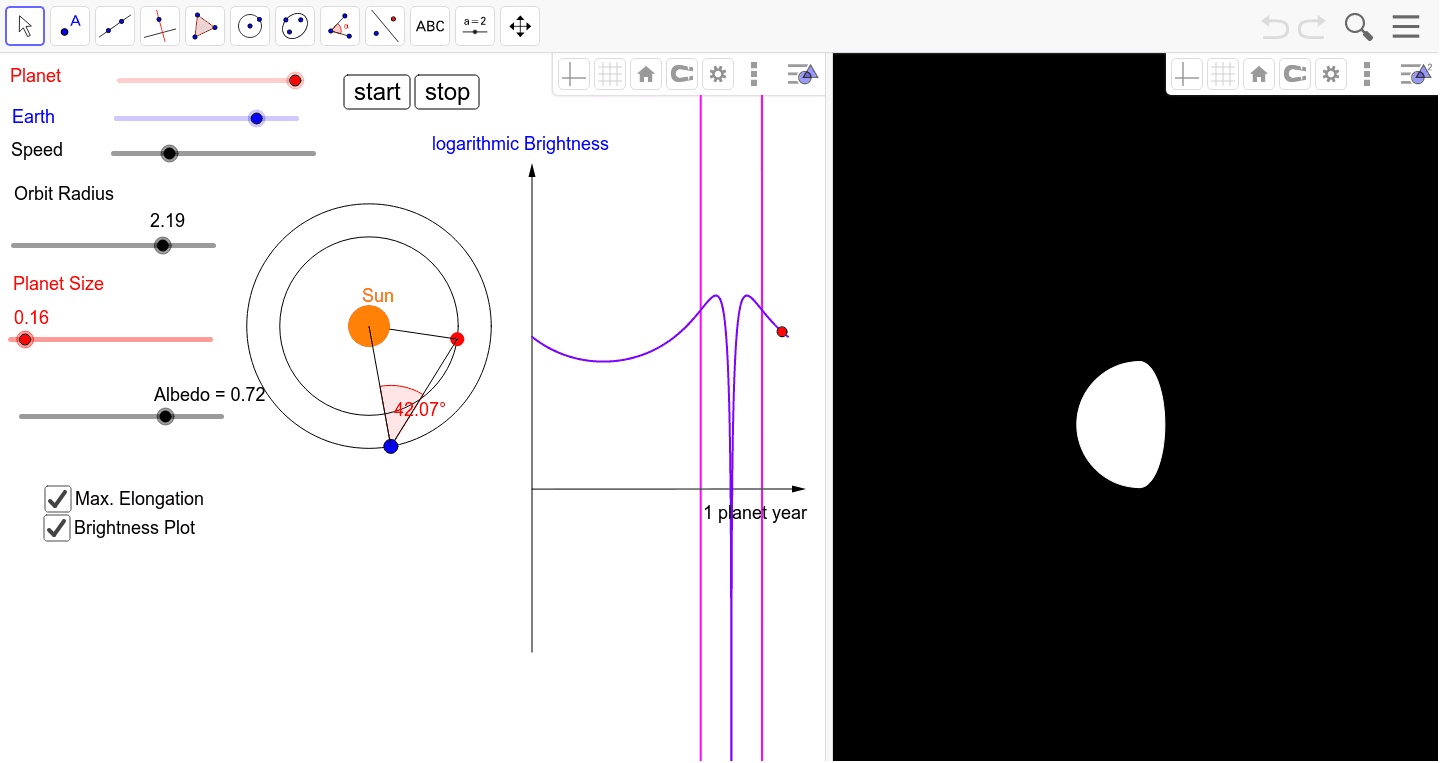
This example demonstrates the phases of inner planets like Mercury and Venus as observed from Earth. It involves core mathematical concepts such as circles, rotations, and loci. The construction utilizes GeoGebra commands like Circle, Rotate, Locus, and Vector. Suitable for high school students studying astronomy and geometry to understand planetary motion and phase changes.
GeoGebra Commands & Parameters
Circle(A, f) → f_1Rotate(B, α, A) → B'Rotate(B, γ, A) → B'_1Ray(A, B'_1) → gIntersect(f_1, g) → C,Segment(C, B') → jCircle(A, m) → pIntersect(p, yAxis) → I, JIntersect(p, xAxis) → K, LCircumcircleSector(F, K, I) → e_1Area(e_1) → s_1Angle(C, B', A) → εCircle(A, e) → qIntersect(q, yAxis) → D, EEllipse(D, E, F) → sArea(s) → t_1Area(s') → w_1Angle(A, C, B') → ζAngle(B, A, B') → βCircle(A, B) → cCircle(B', a) → dTangent(B', c) → b,Angle(B, A, B'_1) → δCircle(C, h) → kTangent(C, f_1) → i,Segment(A, B') → lArea(p) → nPointIn(p) → PunktpArea(s) → oPointIn(s) → Punkts_1If(ε ≥ 90°, x = u, x = t) → a_1Intersect(a_1, xAxis) → GSphere(B', a) → b_1OrthogonalPlane(B', l) → c_1CircumcircleSector(F, L, I) → d_1Angle(g, l) → λCircle(H, 0.5, xOyPlane) → g_1Angle(l, g) → ηLocus(M, α) → Ortslinie1Vector(O, N) → u_1Point(u_1) → PVector(P, Q) → v_1Tangent(C, c) → h_1, i_1Angle(h_1, i_1) → θOrthogonalLine(R, xAxis) → j_1OrthogonalLine(S, v_1, xOyPlane) → k_1Segment(H, C) → l_1Point(Ortslinie1) → TOrthogonalLine(T, v_1, xOyPlane) → m_1Point(m_1) → USegment(U, V) → n_1Point(m_1) → WSegment(W, V) → p_1Locus(V, α) → Ortslinie2PointIn(e_1) → Punkte1PointIn(s) → PunktsPointIn(s') → Punkts'