
Solar System: Helio- and Geocentric Views
Loading the math board and drawing, please wait…
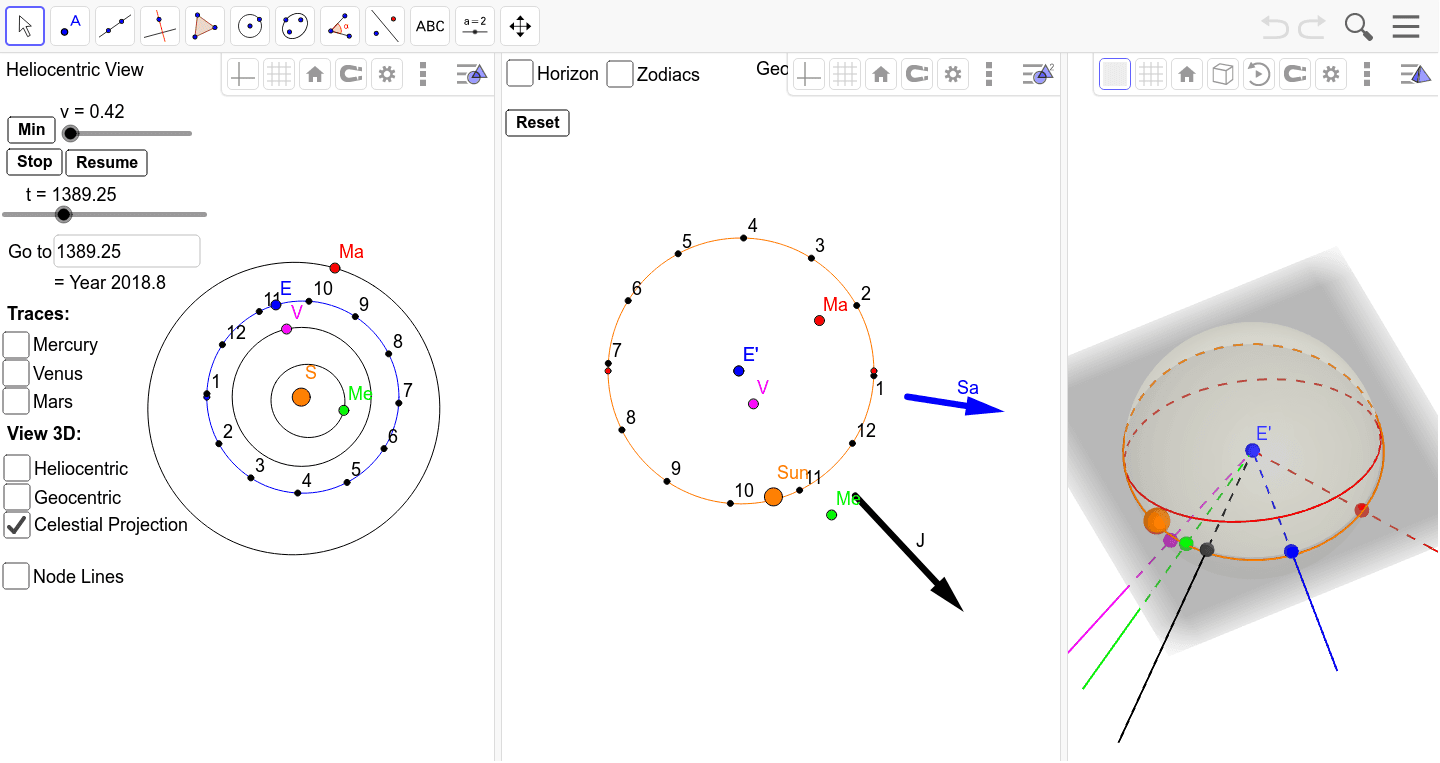
This example demonstrates the calculation and visualization of positions for Mercury, Venus, Earth, Mars, Jupiter, and Saturn from 1600 onwards under both heliocentric and geocentric perspectives. Key math concepts include ellipses, trigonometric functions, multiplication, means, unit circles, and incircles. Construction highlights GeoGebra commands such as Rotate, Vector, Translate, Circle, Ellipse, Line, Intersect, Midpoint, Point, Angle, Root, Distance, Ray, Segment, OrthogonalLine, Textfield, Sphere, Plane, IntersectPath, and Tangent. Suitable for high school students and astronomy enthusiasts studying celestial mechanics and mathematical modeling.
GeoGebra Commands & Parameters
Rotate(C, α + (((0.0167 * 180) * ° / 3.141) * sin(α)) + ((0.5 * (((0.0167 * 180) * ° / 3.141))^(2)) * sin((2 * α))), D) → C'Vector(C', D) → uTranslate(C', u) → C''_1Circle(A, 0.283464) → rEllipse(A, B, C) → cLine(A, I_4) → nIntersect(r, n) → J_2, K_2Midpoint(K_2, A) → L_2Circle(L_2, 1.524) → sIntersect(s, n) → M_2, N_2Ellipse(K_2, A, M_2) → t_2Intersect(t_2, n) → O_2, P_2Point(c) → MRotate(M, ((2 * π) * t / 365.25), C''_1) → M'_1Angle(M, C''_1, M'_1) → ϕRoot(ϕ - x + (0.0167 * sin(x)), 0, 7) → S_3Distance(C''_1, S_3) → EEAngle(C, D, C') → βPoint(c) → ELine(A, L_5) → aCircle(A, 0.16) → dIntersect(d, a) → F, GMidpoint(A, F) → HCircle(H, 0.387) → eIntersect(e, a) → I, JEllipse(F, A, J) → fRotate(J, γ + (((0.206 * 180) * ° / 3.141) * sin(γ)) + ((0.5 * (((0.206 * 180) * ° / 3.141))^(2)) * sin((2 * γ))), H) → J'Angle(J, H, J') → δRay(H, J') → bIntersect(f, b) → K,Segment(C', K) → gTranslate(C', u) → C''Translate(K, u) → K'Segment(C'', K') → g'Segment(D, A) → hTranslate(D, u) → D'Translate(A, u) → A'Segment(D', A') → h'Ray(A, C') → iCircle(A, 0.723) → kRotate(C, ε + (((0.0068 * 180) * ° / 3.141) * sin(ε)) + ((0.5 * (((0.0068 * 180) * ° / 3.141))^(2)) * sin((2 * ε))), A) → C'_1Angle(C, A, C'_1) → ζRay(A, C'_1) → jPoint(c) → NPoint(c) → OPoint(c) → PCircle(C'', A') → pPoint(p) → QPoint(p) → RPoint(p) → SPoint(p) → TPoint(p) → UPoint(c) → VPoint(c) → WPoint(p) → ZPoint(c) → A_1Point(p) → B_1Point(c) → C_1Point(p) → D_1Point(c) → E_1Point(p) → F_1Point(c) → G_1Point(p) → H_1Point(c) → I_1Point(p) → J_1Point(c) → K_1Point(p) → L_1Circle(C'', 1.2) → qRay(C'', A') → mIntersect(q, m) → M_1,Point(q) → N_1Point(q) → O_1Intersect(p, xAxis, 1) → P_1Intersect(p, xAxis, 2) → Q_1Point(q) → R_1Point(q) → S_1Point(q) → T_1Point(q) → U_1Point(q) → V_1Point(q) → W_1Point(q) → Z_1Point(q) → A_2Point(q) → B_2Point(q) → C_2Point(q) → D_2Point(q) → E_2Point(q) → F_2Point(q) → G_2Point(q) → H_2Rotate(O_2, η + (((0.093 * 180) * ° / 3.141) * sin(η)) + ((0.5 * (((0.093 * 180) * ° / 3.141))^(2)) * sin((2 * η))), L_2) → Q_2Angle(O_2, L_2, Q_2) → θ_1Segment(C', Q_2) → a_1Translate(C', u) → C''_2Translate(Q_2, u) → R_2Line(A', C'') → c_1Intersect(q, c_1) → S_2, T_2Rotate(T_2, θ, C'') → U_2Angle(T_2, C'', U_2) → ιLine(C'', U_2) → d_1OrthogonalLine(C'', d_1) → e_1Segment(C'', A') → f_1Point(c) → V_2Circle(A, 0.5) → h_1Line(A, V'_2) → g_1Intersect(h_1, g_1) → W_2, Z_2Midpoint(A, Z_2) → A_3Circle(A_3, 5.2) → k_1Intersect(k_1, g_1) → B_3, C_3Ellipse(Z_2, A, C_3) → p_1Rotate(B_3, ξ + (((0.0484 * 180) * ° / 3.141) * sin(ξ)) + ((0.5 * (((0.0484 * 180) * ° / 3.141))^(2)) * sin((2 * ξ))), A) → D_3Angle(B_3, A, D_3) → νRay(A_3, D_3) → j_1Intersect(p_1, j_1) → E_3,Segment(C', E_3) → l_1Translate(C', u) → C''_3Translate(E_3, u) → F_3Circle(A, 1.033) → q_1Intersect(q_1, xAxis, 2) → J_3Rotate(J_3, 170° + (((n_1 - 2015) * 180) * ° / ((3.141 * 25780))), A) → K_3Line(A, K'_3) → r_1Angle(J_3, A, K_3) → ρIntersect(q_1, r_1) → L_3, M_3Midpoint(A, L_3) → N_3Circle(N_3, 9.5367) → s_1Intersect(s_1, r_1) → O_3, P_3Ellipse(A, L_3, O_3) → t_1Distance(A, P_3) → abstandAP3Distance(A, O_3) → abstandAO3Rotate(P_3, σ + (((0.0539 * 180) * ° / 3.141) * sin(σ)) + ((0.5 * (((0.0539 * 180) * ° / 3.141))^(2)) * sin((2 * σ))), N_3) → Q_3Angle(P_3, N_3, Q_3) → τSegment(Q_3, C') → a_2Translate(Q_3, u) → R_3Translate(C', u) → C''_4Textfield(n_1) → Textfeld1Rotate(M, ((2 * π) * t), C''_1) → M'Textfield(t) → Textfeld2Rotate(M, (2 * atan((sqrt((1 + 0.0167) / (1 - 0.0167)) * tan((0.5 * EE))))), A) → M'_2Angle(M, A, M'_2) → χRay(A, M'_2) → f_2Intersect(c, f_2) → T_3,Rotate(O_2, ((2 * π) * t / ((365.25 * 1.88085))) + β_1, L_2) → W_3Angle(O_2, L_2, W_3) → ψRoot(ψ - x + (0.09341 * sin(x)), 0, 7) → Z_3Distance(C''_1, Z_3) → EMaRotate(O_2, (2 * atan((sqrt((1 + 0.09341) / (1 - 0.09341)) * tan((0.5 * EMa))))) + β_1, A) → B_4Rotate(O_2, (2 * atan((sqrt((1 + 0.09341) / (1 - 0.09341)) * tan((0.5 * EMa))))), A) → A_4Angle(O_2, A, A_4) → ωRay(A, A_4) → g_2Intersect(t_2, g_2) → C_4,Rotate(W_2, ((2 * π) * t / ((365.25 * 11.862615))) + ε_1, A_3) → E_4Angle(W_2, A_3, E_4) → ζ_1Root(ζ_1 - x + (0.04892 * sin(x)), 0, 7) → F_4Distance(C''_1, F_4) → EJRotate(W_2, (2 * atan((sqrt((1 + 0.04892) / (1 - 0.04892)) * tan((0.5 * EJ))))), A) → G_4Angle(W_2, A, G_4) → η_1Ray(A, G_4) → i_2Intersect(p_1, i_2) → H_4,Rotate(P_3, ((2 * π) * t / ((365.25 * 29.47498))) + σ_1, N_3) → J_4Angle(K'_3, N_3, J_4) → σ_2Root(σ_2 - x + (0.05772 * sin(x)), 0, 7) → K_4Distance(C''_1, K_4) → ESRotate(P_3, (2 * atan((sqrt((1 + 0.05772) / (1 - 0.05772)) * tan((0.5 * ES))))), A) → L_4Ray(A, L_4) → j_2Intersect(t_1, j_2) → M_4,Angle(K'_3, A, L_4) → σ_3Rotate(C, 30° + (360° * t / ((365.2425 * 25784))), A) → C'_2Angle(C, A, C'_2) → ι_1Line(A, C'_2) → k_2Circle(A, 0.009822897447999999) → p_2Intersect(p_2, k_2) → N_4, O_4Midpoint(A, N_4) → P_4Circle(P_4, 0.7233356) → q_2Intersect(q_2, k_2) → Q_4, R_4Ellipse(N_4, A, R_4) → r_2Rotate(R_4, ((2 * π) * t / ((365.25 * 0.61519726))) + κ_1, P_4) → S_4Angle(R_4, P_4, S_4) → λ_1Root(λ_1 - x + (0.00679 * sin(x)), 0, 7) → T_4Distance(C''_1, T_4) → EVRotate(R_4, (2 * atan((sqrt((1 + 0.00679) / (1 - 0.00679)) * tan((0.5 * EV))))), A) → U_4Angle(R_4, A, U_4) → μ_1Ray(A, U_4) → l_2Intersect(q_2, l_2) → V_4,Vector(T_3, A) → w_1Translate(T_3, w_1) → W_4Translate(A, w_1) → A'_1Translate(T_3, w_1) → A_5Ray(W_4, A'_1) → s_2Segment(T_3, V_4) → a_3Translate(V_4, w_1) → C_5Segment(W_4, C_5) → b_3Angle(b_3, s_2) → μSegment(T_3, C_4) → c_3Translate(C_4, w_1) → D_5Segment(W_4, D_5) → d_3Ray(D_5, W_4) → e_3Angle(e_3, s_2) → λPoint(p) → I_2Intersect(f, a) → L, D_4Rotate(L, ((2 * π) * t / ((365.25 * 0.2408467))) + α_1, H) → L'Angle(L, H, L') → κRoot(κ - x + (0.20564 * sin(x)), 0, 7) → Z_4Distance(C''_1, Z_4) → EMeRotate(L_5, (2 * atan((sqrt((1 + 0.20564) / (1 - 0.20564)) * tan((0.5 * EMe))))), A) → L'_1Ray(A, L'_1) → lIntersect(f, l) → B_5,Angle(L_5, A, L'_1) → γ_1Segment(T_3, B_5) → b_1Translate(B_5, w_1) → E_5Segment(W_4, E_5) → e_2Angle(e_2, s_2) → δ_1Segment(F_5, G_5) → h_2Segment(T_3, H_4) → m_2Translate(H_4, w_1) → H_5Ray(H_5, W_4) → n_2Point(n_2) → J_5Angle(n_2, s_2) → ν_1Point(n_2) → I_5Circle(W_4, I_5) → f_3Intersect(f_3, n_2) → K_5, M_5Circle(W_4, 1.3) → g_3Intersect(g_3, n_2) → N_5, P_5Segment(A_1, M_4) → m_1Translate(M_4, w_1) → G_3Ray(G_3, W_4) → d_2Angle(s_2, d_2) → οIntersect(g_3, d_2) → H_3, I_3Point(d_2) → R_5Segment(H_5, W_4) → b_2Intersect(g_3, b_2) → U_3,Point(b_2) → V_3Vector(U_3, V_3) → v_1Segment(W_4, G_3) → c_2Intersect(g_3, c_2) → Q_5,Point(c_2) → S_5Vector(Q_5, S_5) → u_1Rotate(C, 233*°, A) → C'_3Rotate(C, 333*°, A) → C'_4Angle(C, A, C'_4) → υLine(A, C'_4) → h_3Rotate(q_2, 3.4*°, h_3) → k_3Rotate(V_4, 3.4*°, h_3) → T_5Angle(C, A, C'_5) → ξ_1Line(A, C'_5) → i_3Rotate(p_1, 1.3*°, i_3) → p_3Rotate(H_4, 1.3*°, i_3) → U_5Rotate(C, 306*°, A) → C'_6Angle(C, A, C'_6) → ο_1Line(A, C'_6) → j_3Rotate(f, 7*°, j_3) → f'Rotate(B_5, 7*°, j_3) → V_5Rotate(C, 309*°, A) → C'_7Angle(C, A, C'_7) → ρ_1Line(A, C'_7) → l_3Rotate(t_2, 1.85*°, l_3) → q_3Rotate(C_4, 1.85*°, l_3) → W_5Rotate(C, 12*°, A) → C'_8Angle(C, A, C'_8) → τ_1Line(A, C'_8) → m_3Rotate(t_1, 2.49*°, m_3) → r_3Rotate(M_4, 2.49*°, m_3) → Z_5Vector(T_3, A) → u_2Translate(A, u_2) → A'_2Translate(V_5, u_2) → A_6Translate(T_5, u_2) → B_6Translate(W_5, u_2) → C_6Translate(xOyPlane, Vector[(0, 0, 0)]) → xyEbene'Translate(U_5, u_2) → D_6Translate(Z_5, u_2) → E_6Sphere(W_4, 1) → w_2Ray(W_4, B_6) → n_3Intersect(n_3, w_2) → F_6, G_6Ray(W_4, A_6) → s_3Intersect(s_3, w_2) → H_6, I_6Ray(W_4, C_6) → t_3Intersect(t_3, w_2) → J_6, K_6Ray(W_4, D_6) → a_4Intersect(a_4, w_2) → L_6, M_6Ray(W_4, E_6) → b_4Intersect(b_4, w_2) → N_6, O_6Segment(W_4, B_6) → c_4Segment(W_4, A_6) → d_4Segment(W_4, A_6) → e_4Segment(W_4, C_6) → f_4Segment(W_4, B_6) → g_4Segment(W_4, D_6) → h_4Segment(W_4, E_6) → i_4Rotate(C_7, 78*°, A) → P_6Angle(C_7, A, P_6) → υ_1Line(A, P_6) → j_4Intersect(c, j_4) → Q_6, R_6Plane(Q_6, j_4) → k_4Plane(Q_6, R_6, C_7) → l_4Rotate(l_4, -23.4*°, j_4) → m_4IntersectPath(m_4, w_2) → p_4Tangent(T_3, q_2) → n_4, q_4Translate(n_4, u_2) → r_4Translate(q_4, u_2) → s_4Tangent(T_3, f) → t_4, a_5Translate(a_5, u_2) → b_5Translate(t_4, u_2) → c_5
AI Drawing Prompt Reference
Create a solar system model showing the positions of six planets from 1600 onwards under both heliocentric and geocentric views. Use ellipses, trigonometric functions, multiplication, means, unit circles, and incircles to visualize orbits and positions, employing rotations, vectors, translations, and geometric constructions suitable for high school students and astronomy enthusiasts.
The prompt above was compiled from the original drawing commands and is for reference only.