
Solar Panel Collecting Sunlight During Day by Terry Lee Lindenmuth
Loading the math board and drawing, please wait…
In collections
Rate & Accumulation Yr 4 Much&Fast
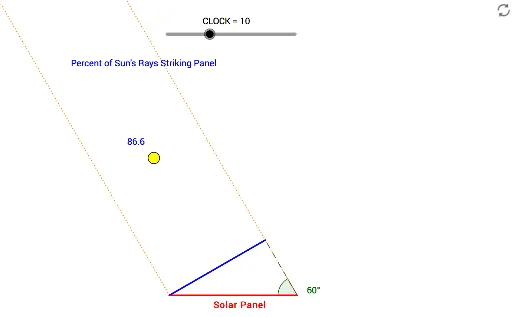
This example demonstrates how a solar panel collects sunlight during the day. Key mathematical concepts include angles, vectors, and rotation. Using GeoGebra commands such as Point, Segment, Rotate, and Angle, the dynamic changes in the solar panel's position can be constructed. Suitable for high school or university geometry and physics courses.
GeoGebra Commands & Parameters
Point(xAxis) → APoint(xAxis) → BSegment(A, B) → fRotate(A, (-Angle), B) → A'Angle(A', B, A) → αRay(B, A') → gOrthogonalLine(A, g) → hIntersect(g, h) → CLine(A, g) → iPoint(i) → DRay(A, D) → jPolygon(A, B, C) → poly1, c, a, bRotate(B, PmAngle, A) → B'Angle(B, A, B') → βOrthogonalLine(B, j) → kIntersect(j, k) → EPolygon(A, B, E) → poly2, e, a_1, b_1Point(g) → FOrthogonalLine(F, j) → lIntersect(j, l) → GMidpoint(G, F) → HText(PercentHits) → text3Text(PmHits) → text2
AI Drawing Prompt Reference
Draw a diagram showing a solar panel collecting sunlight during the day. Include a sunlight ray and a solar panel formed by two segments, one rotating around the other. Label the angle between the panel and the ray, and show vectors. Add a vertical line from the panel to the ray, forming a triangle at their intersection. As the panel rotates, the intersection point and triangle change dynamically, illustrating the collection of sunlight.
The prompt above was compiled from the original drawing commands and is for reference only.