
Soccer 2v2 - Positioning, Angles, and Dilations
Loading the math board and drawing, please wait…
In collections
Soccer & Geometry: Positions, Angles, & Dilations
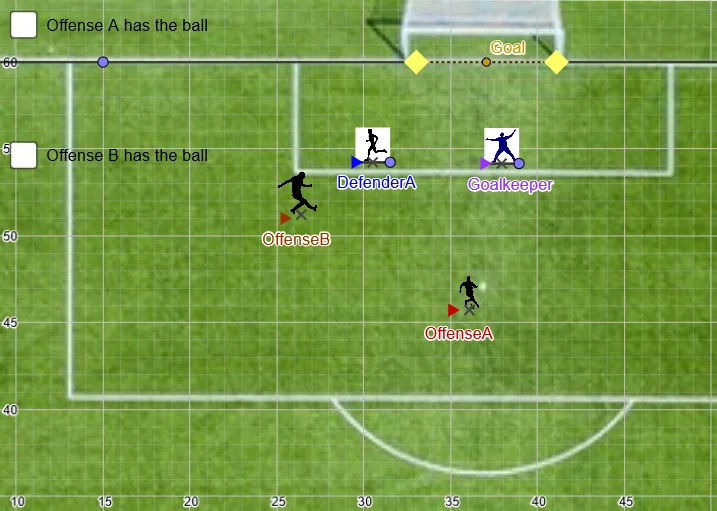
This example demonstrates the geometric principles behind soccer positioning, angles, and dilations used by players and coaches. Core math concepts include angles, area, dilation, geometric transformations, similarity transformations, and geometric constructions. It uses GeoGebra commands like Point, Line, Midpoint, Circle, Segment, Distance, Intersect, Polygon to model player positions, goal paths, and scaling effects. Ideal for high school mathematics education to explore geometry in sports applications.
GeoGebra Commands & Parameters
Point(yAxis) → ALine(A, B) → fPoint(f) → CPoint(f) → DPoint(f) → EPoint(f) → FMidpoint(E, F) → GoalCircle(Goal, OffenseA) → cPoint(Circle[OffenseA, 2]) → KSegment(OffenseA, K) → hMidpoint(OffenseA, K) → LPoint(Circle[Goalkeeper, 2]) → NSegment(Goalkeeper, N) → jMidpoint(Goalkeeper, N) → MDistance(L, M) → distanceLMDistance(L, M) → dDistance(M, Goal) → distanceMGoalPoint(Circle[OffenseB, 2]) → VSegment(OffenseB, V) → rMidpoint(OffenseB, V) → GPoint(Circle[DefenderA, 2]) → SSegment(DefenderA, S) → tMidpoint(DefenderA, S) → B_1Line(V, DefenderA) → p_2Line(V, S) → q_2Line(V, Goalkeeper) → a_2Line(V, N) → b_2Point(p_2) → O_1Point(a_2) → U_1Line(O_1, f) → c_2Line(U_1, f) → e_2Intersect(q_2, c_2) → V_1Intersect(e_2, b_2) → Z_1Polygon(U_1, Z_1, V) → t8, v_2, u_1, z_1Polygon(O_1, V_1, V) → t9, v_3, g_3, h_3Midpoint(O_1, V_1) → H_2Midpoint(U_1, Z_1) → J_2Polygon(V, OffenseA, K) → t11, k_3, v_5, offenseaPolygon(V, E, F) → t12, f_4, v_6, e_3Line(K, DefenderA) → i_3Line(K, S) → j_3Line(K, Goalkeeper) → n_3Line(K, N) → p_3Point(i_3) → QPoint(n_3) → RLine(Q, f) → nLine(R, f) → q_3Intersect(n, j_3) → B_2Intersect(q_3, p_3) → C_2Intersect(f, i_3) → E_2Intersect(f, j_3) → F_2Intersect(f, n_3) → G_2Intersect(f, p_3) → K_2Midpoint(Q, B_2) → A_1Midpoint(R, C_2) → N_2Polygon(Q, B_2, K) → t14, k_5, q_4, a_3Polygon(R, C_2, K) → t15, c_3, d_3, g_4Polygon(K, V, OffenseB) → t17, i_4, k_7, v_7Polygon(K, E, F) → t18, f_5, k_8, e_4
AI Drawing Prompt Reference
Draw a soccer field with positions for two attacking players, one defender, and a goalkeeper. Use circles to represent the players' activity zones and lines to show their coordination. Calculate and display the distances between players, constructing angles and areas geometrically to illustrate scaling effects during player movements.
The prompt above was compiled from the original drawing commands and is for reference only.