
Slope: Intuitive Introduction and Exploration
Loading the math board and drawing, please wait…
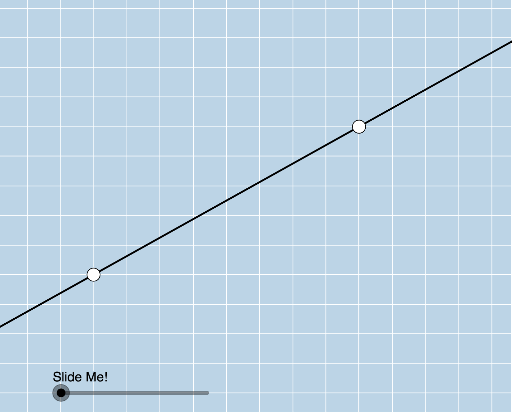
This GeoGebra example dynamically illustrates the concept of slope for a line, allowing users to interactively modify the line and observe changes in slope. The core mathematical concepts involved include the definition of slope, linear equations, and the geometric interpretation of rate of change. The construction utilizes various GeoGebra commands such as GCD, If, OrthogonalLine, Intersect, Line, Polygon, Distance, Segment, Angle, Slope, Dilate, Vector, Midpoint, Mirror, along with objects like points A and B, deltaY, deltaX, and others, to create a modifiable diagram that calculates and displays slope in real-time. It is suitable for middle or high school mathematics education, providing an intuitive way to explore slope properties.
GeoGebra Commands & Parameters
GCD(deltaY, deltaX) → GCDmGCD(numerYint, deltaX) → GCDyIf(sgn(deltaY / deltaX) ≥ 0, "", "-") → textSignNIf(sgn(numerYint / deltaX) > 0, "+", "-") → textSignIf(deltaXR ≟ 1, textSignN + deltaYR, textSignN + "\, \frac{" + deltaYR + "}{" + deltaXR + "}") → textslopeNIf(denomYintR ≟ 1, textSign + numerYintR, textSign + "\frac{" + numerYintR + "}{" + denomYintR + "}") → textYintIf(denomYintR ≟ 1, If[numerYintR ≟ 1, textSign, textSign + numerYintR], textSign + "\frac{" + numerYintR + "}{" + denomYintR + "}") → textMIDOrthogonalLine(B, xAxis) → a_2OrthogonalLine(A, yAxis) → cIntersect(a_2, c) → CLine(A, B) → dPolygon(A, B, C) → poly1, c_1, a_1, b_1Distance(B, C) → distanceBCDistance(A, C) → distanceACIntersect(a_2, c) → DSegment(A, D) → eSegment(C, B) → fGCD(deltaY_1, deltaX_1) → GCDm_1If(sgn(deltaY_1 / deltaX_1) ≥ 0, "", "-") → textSignN_1If(deltaXR_1 ≟ 1, textSignN_1 + deltaYR_1, textSignN_1 + "\, \frac{" + deltaYR_1 + "}{" + deltaXR_1 + "}") → textslopeN_1Line(A_1, B_1) → d_1Angle(B, D, A) → αSegment(A, B) → gGCD(deltaY_2, deltaX_2) → GCDm_2If(sgn(deltaY_2 / deltaX_2) ≥ 0, "", "-") → textSignN_2If(deltaXR_2 ≟ 1, textSignN_2 + deltaYR_2, textSignN_2 + "\, \frac{" + deltaYR_2 + "}{" + deltaXR_2 + "}") → textslopeN_2Line(A_2, B_2) → d_2Segment(A_2, B_2) → g_1GCD(deltaY_3, deltaX_3) → GCDm_3If(sgn(deltaY_3 / deltaX_3) ≥ 0, "", "-") → textSignN_3If(deltaXR_3 ≟ 1, textSignN_3 + deltaYR_3, textSignN_3 + "\, \frac{" + deltaYR_3 + "}{" + deltaXR_3 + "}") → textslopeN_3Line(A_3, B_3) → d_3Segment(A_3, B_3) → g_2Slope(g) → hDilate(A, If[0 < i ≤ 1, 1 - i, 0], D) → A'Vector(A, A') → uDilate(D, If[1 < i ≤ 2, 2 - i, 0], B) → D'Vector(D, D') → vLine(A, B) → jMidpoint(A, C) → EMirror(B, k) → B'Distance(A, B') → distanceAB'Distance(B', B) → distanceB'BPolygon(A, B', B) → t1, b_5, a_6, b'Dilate(A, If[0 < i ≤ 1, 1 - i, 0], B') → A'_1Vector(A, A'_1) → wDilate(B', If[1 < i ≤ 2, 2 - i, 0], B) → B''Vector(B', B'') → lIntersect(m, n) → FDilate(A, If[0 < i ≤ 1, 1 - i, 0], F) → A'_2Vector(A, A'_2) → pDilate(F, If[1 < i ≤ 2, 2 - i, 0], B) → F'Vector(F, F') → qDistance(A, F) → distanceAFDistance(F, B) → distanceFBPolygon(A, F, B) → t3, b_6, a_7, f_1