
Skeletal Octahedron Folding Animation
Loading the math board and drawing, please wait…
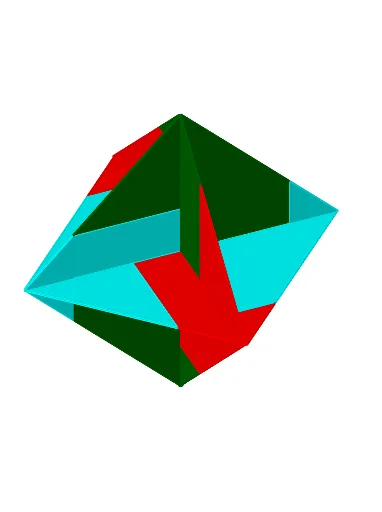
This example demonstrates the folding process of a skeletal octahedron from the book 'Action Modular Origami'. Key mathematical concepts include geometric construction and transformation. It uses commands such as Point, Intersect, Line, Polygon, Dilate, Plane, Mirror, OrthogonalLine, Sequence, Vector, Translate, Rotate. Suitable for teaching solid geometry and geometric construction.
GeoGebra Commands & Parameters
Point(zAxis) → APoint(yAxis) → BPoint(xAxis) → CPoint(yAxis) → DPoint(xAxis) → EPoint(zAxis) → FIntersect(zAxis, xOyPlane) → OLine(O, Z) → aPolygon(B, C, D, E) → poly1, b, c, d, ePolygon(B, F, D, A) → poly2, b_1, f, d_1, a_1Polygon(E, F, C, A) → poly3, e_1, f_1, c_1, a_2Dilate(A, scalefactor, O) → A'Dilate(B, scalefactor, O) → B'Dilate(C, scalefactor, O) → C'Dilate(D, scalefactor, O) → D'Dilate(E, scalefactor, O) → E'Dilate(F, scalefactor, O) → F'Plane(F', C', D') → gMirror(O, g) → O'Line(E, C) → hLine(B, D) → iOrthogonalLine(C', h, xOyPlane) → jIntersect(j, b) → GIntersect(j, c) → HOrthogonalLine(G, i, xOyPlane) → kIntersect(i, yAxis) → IIntersect(i, yAxis) → JIntersect(k, i) → KPolygon(O, C', H, C, G, K) → poly10, o, c'_2, h_1, c_2, g_1, k_1Mirror(G, i) → G'Polygon(B, G, K, O, E', G') → poly11, b_2, g_2, k_2, o_1, e', g'Sequence(Rotate[poly10, (n * 180°), O], n, 0, 2) → ListPolyXY1Sequence(Rotate[poly11, (n * 180°), O], n, 0, 2) → ListPolyXY2Vector((0, 0, 0), (0, 0, sep)) → uTranslate(ListPolyXY1, u) → ListPolyXY1'_1Translate(ListPolyXY2, u) → ListPolyXY2'_1Rotate(ListPolyXY1'_1, 180°, h) → ListPolyXY1'Rotate(ListPolyXY2'_1, 180°, h) → ListPolyXY2'Translate({ListPolyXY1, ListPolyXY1'}, Vector[(0, 0, 0), (0, 0, 0)]) → ListPoly1Translate({ListPolyXY2, ListPolyXY2'}, Vector[(0, 0, 0), (0, 0, 0)]) → ListPoly2Line(O, F) → mRotate(ListPoly1, 120°, a) → ListPoly1'Rotate(ListPoly2, 120°, a) → ListPoly2'Rotate(ListPoly1', 120°, a) → ListPoly1''Rotate(ListPoly2', 120°, a) → ListPoly2''Line(O, F) → lRotate({ListPoly1'', ListPoly2'}, α, l) → list2Rotate({ListPoly1', ListPoly2}, α, l) → list1Rotate({ListPoly1, ListPoly2''}, α, l) → list0
AI Drawing Prompt Reference
Draw a skeletal octahedron with six vertices on the coordinate axes, three positive and three negative. Scale all vertices about the origin to create an inner octahedron. Connect corresponding outer and inner vertices to form triangular and quadrilateral faces. Rotate and copy these faces around the axes to create a symmetric folded structure. Finally, rotate the whole assembly about a vertical axis and translate it to show the folding animation.
The prompt above was compiled from the original drawing commands and is for reference only.